

Neumann BCM104 Broadcast Cardioid Condenser Microphone
No longer available at zZounds
zZounds Gear Experts Say...
Internally switchable proximity effect compensation and sensitivity reduction.
Overview
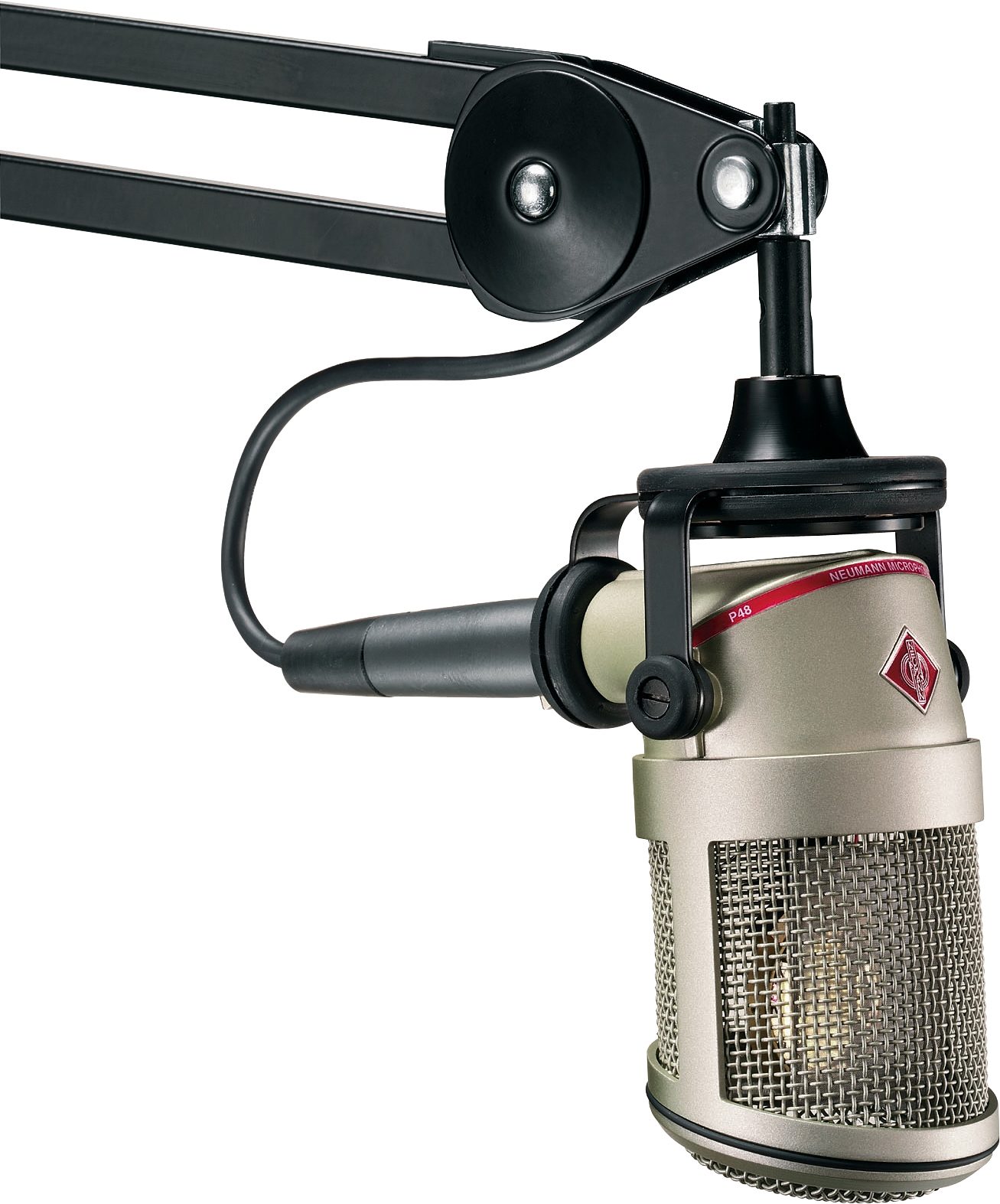
The BCM 104 condenser microphone is the first product in the new Broadcast Line, which is especially tailored to the demands of professional radio announcing.
What sets the Broadcast Line apart is a completely independent, functionally-optimized design derived from extensive 3D simulations.
The large-diaphragm condenser capsule used in the BCM 104 has a cardioid directional pattern with internally switchable proximity effect compensation. A second switch allows the sensitivity to be reduced by 14 dB.
The microphone headgrill twists off easily for quick cleaning. Neumann offers optional, color-coded headgrills so that, for reasons of hygiene, each announcer working at an announcing desk can use his or her individual headgrill.
Directly in front of the capsule, mounted on a frame holder, is a piece of fine gauze that serves as a built-in popscreen.
The BCM 104 has an elastic mount against structure-borne noise, that is compatible with standard broadcast-segment microphone arms.
Features
Cardioid microphone for broadcast & studio
Large diaphragm condenser capsule with
switchable proximity compensation
Distinctive design
Integrated pop screen
Quick release head grille for easy cleaning
Individual head grilles available for each user
Acoustic features
The microphone headgrill houses the K 04 large-diaphragm capsule, which has a flat frequency response up to 3 kHz. Higher frequencies have an increased presence of 2 dB maximum.
Since the above-mentioned microphone characteristics… read more are obtained without the use of resonance effects, the microphone features excellent transient response and transmits all transient phenomena of music and speech without any coloration.
The integrated Pop Screen
A pop screen not only prevents the occurrence of plosive pop noises in vocal recordings, but also efficiently prevents unwanted particles, from respiratory moisture, nicotine, to food remnants, from settling on the diaphragm.
The pop screen can be removed for cleaning without the use of tools.
Electrical features
Instead of a transformer to couple the microphone output to the supply voltage, the BCM 104 has an electronic circuit which, like a transformer, provides for good common mode rejection.
Interference induced in the balanced modulation line is thus suppressed as usual.
With a very low self-noise of 7 dB(A), and an overload capability extending to 138 dB SPL, the BCM 104 has a dynamic range of 131 dB (DIN/IEC 651).
Filter and Preattenuation
The BCM 104 amplifier has a linear operation down to 20 Hz. An active filter efficiently suppresses signals below this frequency. In order to compensate for the proximity effect, a high-pass filter, electronically activated by a switch, is built into the microphone. This filter reduces frequencies below 100 Hz by 12 dB/octave.
A 14-dB preattenuation switch is provided in order to adjust the sensitivity, if necessary, to transmission circuits designed for dynamic microphones. But this will increase the self noise by 14 dB.
Both switches are located inside the microphone housing, since they will normally be operated only once, when the broadcasting facility is set up.
Mounting
The preferred mode of operation is to suspend the BCM 104 from a standard studio boom arm. A thread adapter to fit different connector threads is included.
In order to provide protection from structure-borne noise, both the capsule and the microphone in its mount are elastically suspended.
The optional SG 5 swivel mount allows additional angling of the BCM 104 by +/-90 degrees.
Application hint
While designed to be an announcer's mic for broadcasting and studio, this is just one of the most common applications. With additional experimentation, you will gain maximum use from this microphone. read less
What sets the Broadcast Line apart is a completely independent, functionally-optimized design derived from extensive 3D simulations.
The large-diaphragm condenser capsule used in the BCM 104 has a cardioid directional pattern with internally switchable proximity effect compensation. A second switch allows the sensitivity to be reduced by 14 dB.
The microphone headgrill twists off easily for quick cleaning. Neumann offers optional, color-coded headgrills so that, for reasons of hygiene, each announcer working at an announcing desk can use his or her individual headgrill.
Directly in front of the capsule, mounted on a frame holder, is a piece of fine gauze that serves as a built-in popscreen.
The BCM 104 has an elastic mount against structure-borne noise, that is compatible with standard broadcast-segment microphone arms.
Features
Cardioid microphone for broadcast & studio
Large diaphragm condenser capsule with
switchable proximity compensation
Distinctive design
Integrated pop screen
Quick release head grille for easy cleaning
Individual head grilles available for each user
Acoustic features
The microphone headgrill houses the K 04 large-diaphragm capsule, which has a flat frequency response up to 3 kHz. Higher frequencies have an increased presence of 2 dB maximum.
Since the above-mentioned microphone characteristics… read more are obtained without the use of resonance effects, the microphone features excellent transient response and transmits all transient phenomena of music and speech without any coloration.
The integrated Pop Screen
A pop screen not only prevents the occurrence of plosive pop noises in vocal recordings, but also efficiently prevents unwanted particles, from respiratory moisture, nicotine, to food remnants, from settling on the diaphragm.
The pop screen can be removed for cleaning without the use of tools.
Electrical features
Instead of a transformer to couple the microphone output to the supply voltage, the BCM 104 has an electronic circuit which, like a transformer, provides for good common mode rejection.
Interference induced in the balanced modulation line is thus suppressed as usual.
With a very low self-noise of 7 dB(A), and an overload capability extending to 138 dB SPL, the BCM 104 has a dynamic range of 131 dB (DIN/IEC 651).
Filter and Preattenuation
The BCM 104 amplifier has a linear operation down to 20 Hz. An active filter efficiently suppresses signals below this frequency. In order to compensate for the proximity effect, a high-pass filter, electronically activated by a switch, is built into the microphone. This filter reduces frequencies below 100 Hz by 12 dB/octave.
A 14-dB preattenuation switch is provided in order to adjust the sensitivity, if necessary, to transmission circuits designed for dynamic microphones. But this will increase the self noise by 14 dB.
Both switches are located inside the microphone housing, since they will normally be operated only once, when the broadcasting facility is set up.
Mounting
The preferred mode of operation is to suspend the BCM 104 from a standard studio boom arm. A thread adapter to fit different connector threads is included.
In order to provide protection from structure-borne noise, both the capsule and the microphone in its mount are elastically suspended.
The optional SG 5 swivel mount allows additional angling of the BCM 104 by +/-90 degrees.
Application hint
While designed to be an announcer's mic for broadcasting and studio, this is just one of the most common applications. With additional experimentation, you will gain maximum use from this microphone. read less
Specs
Acoustical operating principle: Pressure gradient transducer
Directional pattern: Cardioid
Frequency range: 20 Hz -- 20 kHz
Sensitivity at 1 kHz into 1 kohm: 22 mV/Pa
-14 dB attenuation: 4.4 mV/Pa
Rated impedance: 50 ohms
Rated load impedance: 1000 ohms
Equivalent SPL CCIR 468-3: 18 dB
Equivalent SPL DIN/IEC 651: 7 dB-A
S/N ratio CCIR 468-3: 76 dB
S/N ratio DIN/IEC 651: 87 dB
Maximum SPL for THD 0.5%: 138 dB
Maximum SPL for THD 0.5% with preattenuation: 152 dB
Maximum output voltage: 10 dBu
Dyn. range of the mic. amplifier DIN/IEC 651: 131 dB
Supply voltage: 48 V +/- 4 V
Current consumption: 3.2 mA
Matching connector: XLR 3 F
Weight: 500 g
Diameter: 64 mm
Length: 85 mm
Directional pattern: Cardioid
Frequency range: 20 Hz -- 20 kHz
Sensitivity at 1 kHz into 1 kohm: 22 mV/Pa
-14 dB attenuation: 4.4 mV/Pa
Rated impedance: 50 ohms
Rated load impedance: 1000 ohms
Equivalent SPL CCIR 468-3: 18 dB
Equivalent SPL DIN/IEC 651: 7 dB-A
S/N ratio CCIR 468-3: 76 dB
S/N ratio DIN/IEC 651: 87 dB
Maximum SPL for THD 0.5%: 138 dB
Maximum SPL for THD 0.5% with preattenuation: 152 dB
Maximum output voltage: 10 dBu
Dyn. range of the mic. amplifier DIN/IEC 651: 131 dB
Supply voltage: 48 V +/- 4 V
Current consumption: 3.2 mA
Matching connector: XLR 3 F
Weight: 500 g
Diameter: 64 mm
Length: 85 mm
Documents and Manuals
For support or warranty questions, please contact the manufacturer:
Phone: 860-598-7555
Web: https://www.neumann.com/en-en/contact/
Phone: 860-598-7555
Web: https://www.neumann.com/en-en/contact/
No longer available at zZounds
In most cases, a product is unavailable because it has been discontinued by the manufacturer

This is a carousel with product cards. Use the previous and next buttons to navigate.
People who bought this item also bought

Universal Audio Apollo Twin X Duo Gen 2 Thunderbolt Audio Interface, Analog Classics Edition
$999.00
- 12 payments of$83.25/mo
- No Credit Check6 payments of$166.50/mo
-

Yamaha HS5 Active Studio Monitor
$199.99
- No Credit Check6 payments of$33.33/mo
Comes in 2 Quantities, 2 Colors-

Yamaha HS8 Active Studio Monitor
$398.99
- 8 payments of$49.87/mo
- No Credit Check6 payments of$66.50/mo
Comes in 2 Quantities, 2 Colors-

Audio-Technica ATH-M50x Headphones
$159.00
- No Credit Check6 payments of$26.50/mo
Comes in 2 Colors, 2 Mfg Models-
Warm Audio WA-HR HeadRoom Closed-Back Studio Headphones
$139.00
- No Credit Check6 payments of$23.17/mo
-
Solid State Logic SSL 2+ MKII 2x4 USB-C Audio Interface
$249.99
- No Credit Check6 payments of$41.66/mo
-
