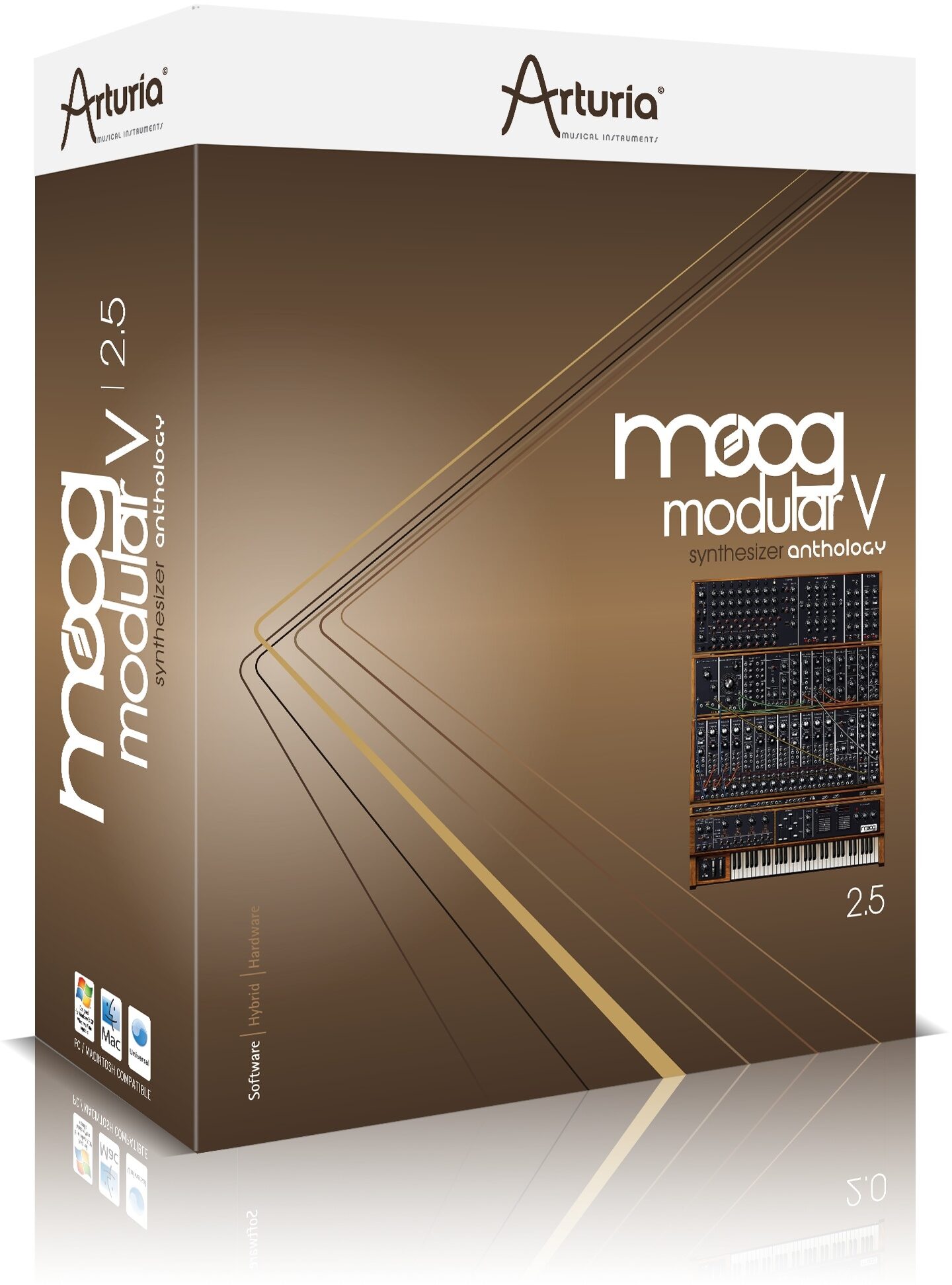
Arturia Moog Modular V Software Synth (Macintosh and Windows)
No longer available at zZounds
zZounds Gear Experts Say...
Up to 64 voices per instrument. Compatible with Intel-based Macs.
Overview
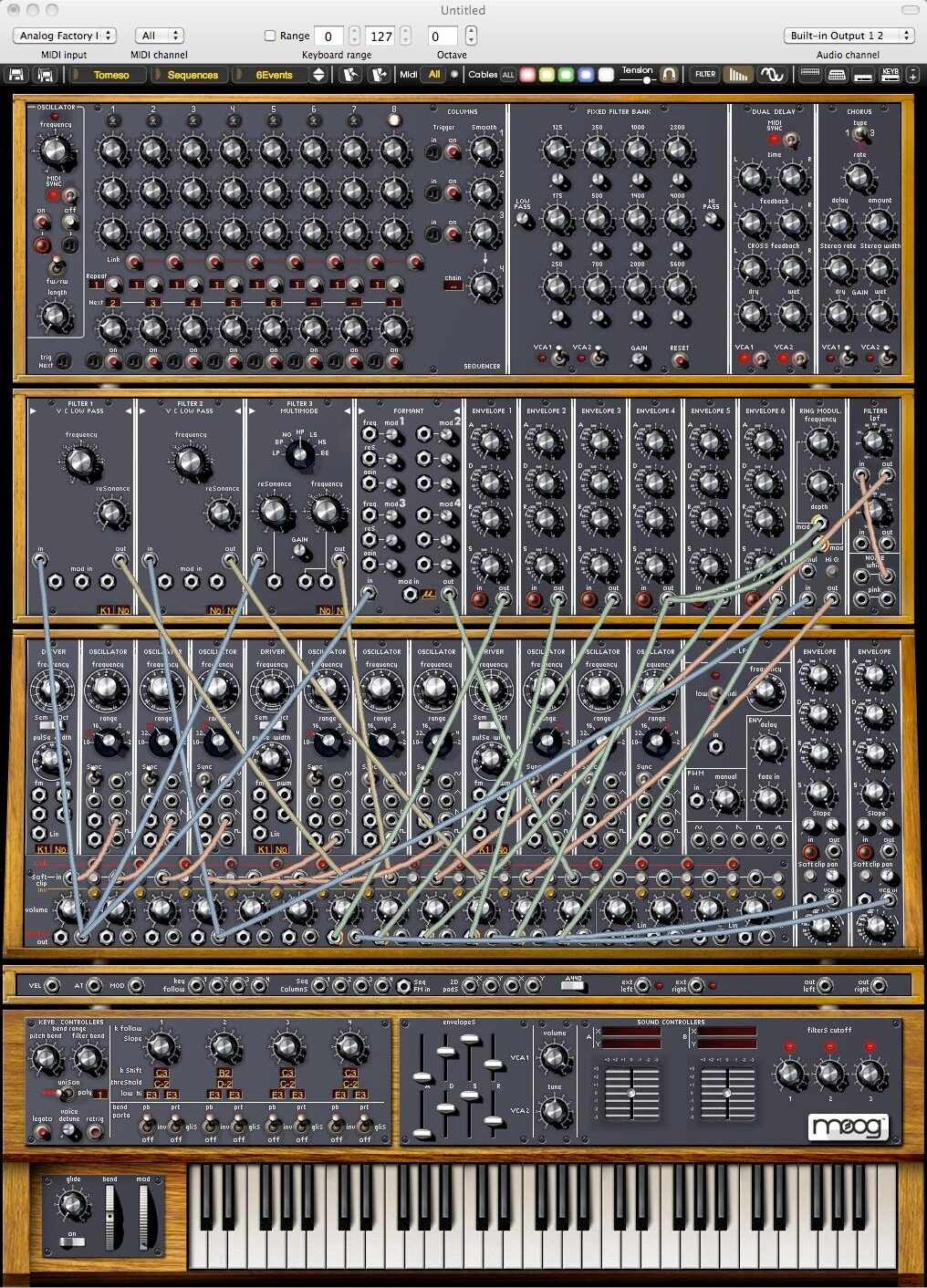
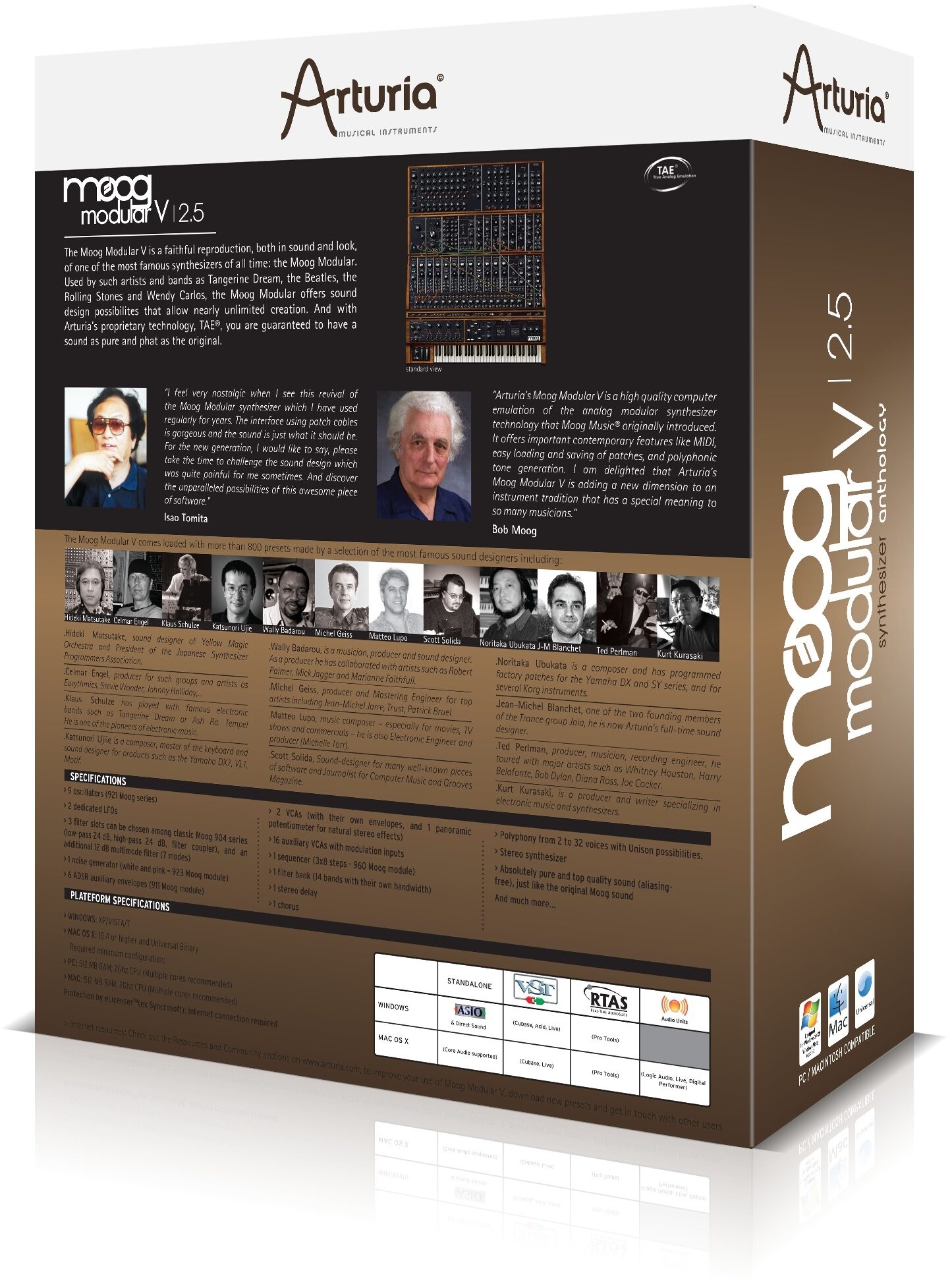
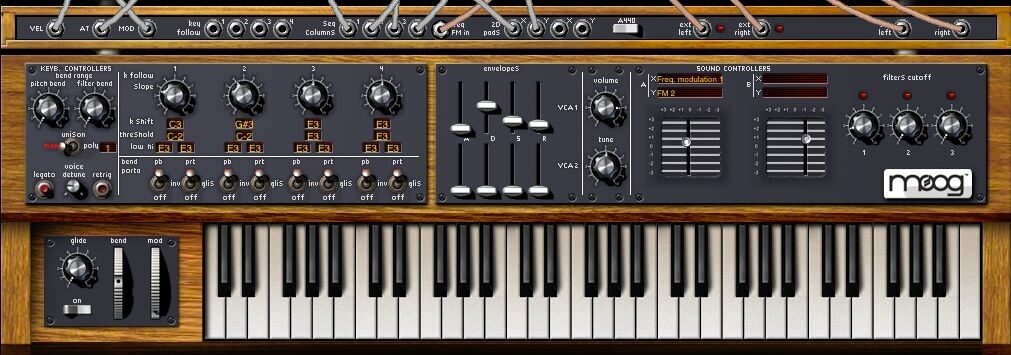
Ever dreamed of using one of the best synthesizers ever made? Ever dreamed of working with a modular system whose sound is part of musical legend? Arturia, in partnership with Bob Moog, has made a faithful reproduction of one of the most famous series of synthesizers: Moog Modular. Whether recreating the abstract tonal qualities of the classic electronic soundtracks, or pushing forward the sonic boundaries of today, the Moog Modular V is the synthesizer of choice for sound exploration, anywhere, anytime. It has all the vibe and the fat sound of the original, cleverly combined with important contemporary features like polyphony, MIDI control, loading and saving of patches.
A Little Bit Of History
It was in 1964 that the first prototype of a Moog synthesizer was produced. It was presented at the AES Show (Audio Engineering Society) and immediately generated a huge amount of interest. In 1965 Bob Moog decided to release the 900 series for commercial sale, and in 1967 he made the decision to produce different machines, each with a certain number of modules. This marked the birth of modular systems I, II and III.
"Probably the number one system" (Peter Forrest, The A-Z of Analog Synthesizers), the Moog Modular was soon to be adopted by groups like Tangerine Dream, The Beatles and the Rolling Stones. Stevie Wonder, Klaus Schultze, Isao Tomita and many others including Jean-Michel Jarre and Keith Emerson were also among the users.
Endless Synthesis
Because it is modular, the Moog… read more Modular V offers endless possibilities for synthesis.
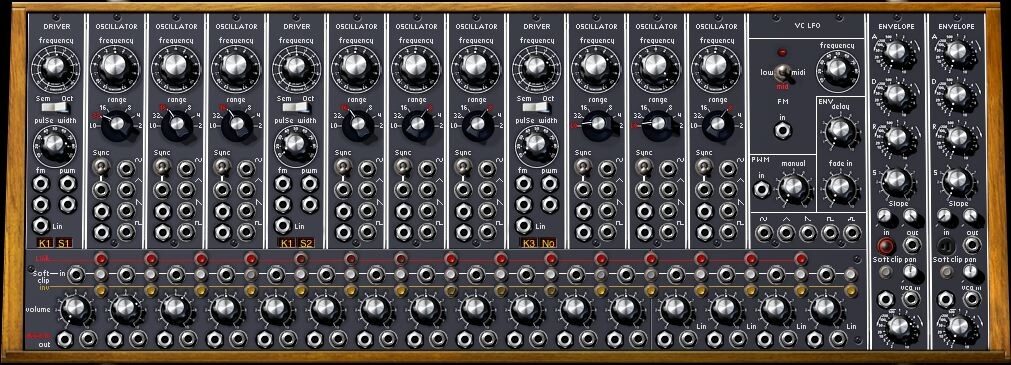
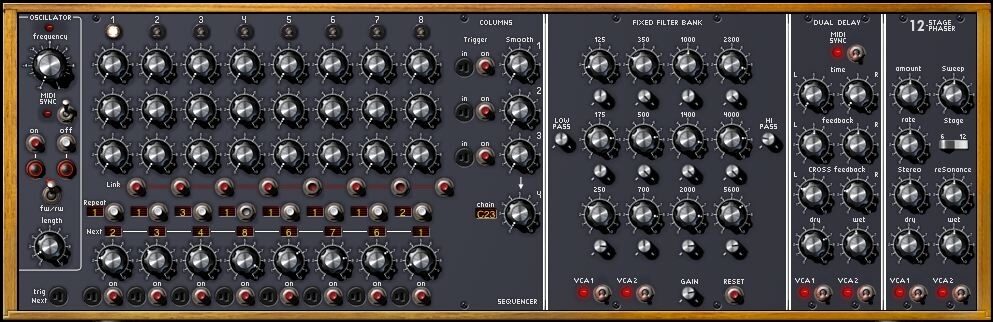
Nine oscillators, three filter slots, two LFOs, six envelopes, VCAs, mixers, triggers, a 3x8 step-sequencer, and more.
With such an instrument, you can make all types of combinations and create sounds that were never heard before.
Pure Analog
TAE, standing for True Analog Emulation, is a new technology developed by Arturia, enabling the digital reproduction of analog circuits. The implementation of TAE in Moog Modular V results in:
- aliasing-free oscillators, at no extra CPU cost.
- better reproduction of analog oscillators: the condensers' unload and the oscillators' instability are simulated, helping to reproduce a typical warm sound.
- very accurate reproduction of the legendary Moog 24 dB low-pass filter.
- implementation of soft clipping, i.e. reproduction of the filters' current limiting function.
What's New In Moog Modular V2.5?
Sound quality improvement:
- VCF audio quality improvements.
- better Audio Unit compatibility (Digital Performer most notably).
Performance improvement:
- ability to use NRPN midi messages for automation.
- better handling of control surfaces while changing preset.
- midi RPN "pitch bend range" message is now recognized.
New ergonomics:
- One unique scrollable view to overlook the entire synth.
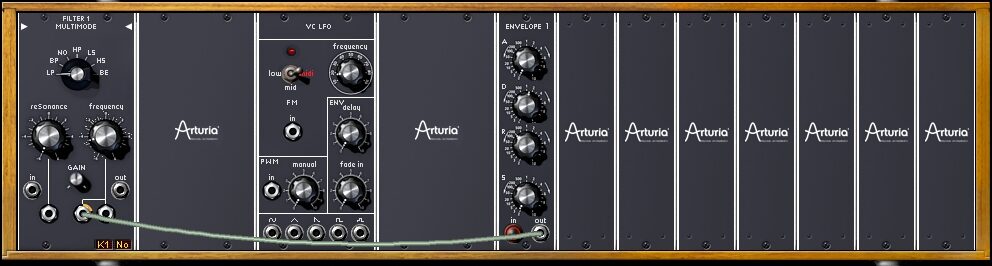
- Some of the modules are now interchangeable, allowing to configure - to a certain extent - the Modular the desired way.
New audio possibilities:
- Improvements on the oscillators (new free running), on the filters (better response to modulations), on the envelopes (faster and even closer to true analogical behavior).
- New Unison mode
- New Audio-In possibilities
- The Soft-clipping emulation is now done on each mixer and not systematically on all of them, which saves on CPU load.
New modules:
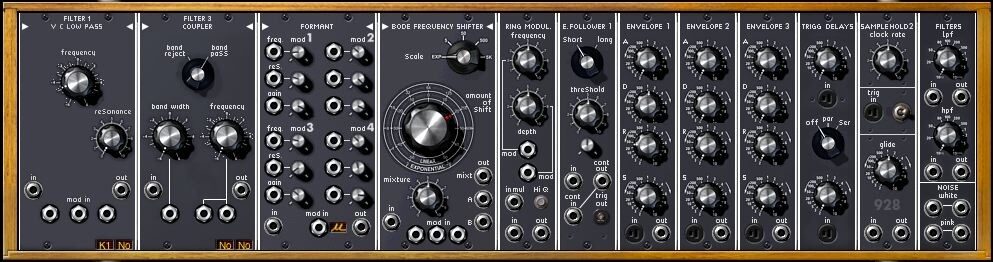
- 1630 Bode Frequency Shifter. Developed under the Moog license by Harold Bode in 1964, it is extremely rare (a dozen Worldwide).
- 928 Sample and hold is also very rare. Originally assembled in a separate cabinet, it was adapted on the last modular series, in the late 70's.
- 912 Envelope follower (or Schmit Trigger). One of the most popular modules on the Moog systems, it was often added to original configuration to create complex modulation through the use of an output signal.
- 12 stage phaser. The Moog 12 Stage Phaser was very well known, and originally conceived as an external rack to the Modular systems.
- Formant Filter. A new module developed by Arturia, which did not exist on the original Moog systems. It allows the filtering of sounds according to the formants a, e, i, o, u.
- Ring Modulator. Also a new module developed by Arturia, it creates very metallic sounds.
New presets:
- 200 new presets to provide optimal use of the new modules.
New in Version 2.5:
- Switch to Syncrosoft copy protection
- VCF audio quality improvements
- Lower CPU utilization on Mac OSX
- Better Audio Unit compatibility (Digital Performer most notably)
- Ability to use NRPN midi messages for automation
- better handling of control surfaces while changing preset
- new presets added
- midi RPN "pitch bend range" message is now recognized
- bug fixes
Standard Features:
- All the parameters of the original Moog Modular: 9 oscillators, 2 LFOs, 3 filter slots, 1 Noise Generator, 6 envelopes, 2 VCAs
- 16 auxiliary VCAs with modulation inputs
- 24-step sequencer
- 1 filter bank (14 bandwidths available)
- More than 600 presets, made by professionals
- Main stereo outputs
- Mono / polyphonic (up to 64 voices per instrument)
- Soft clipping function
- No aliasing from 0.1 Hz to 16 kHz
- 64-bit floating point precision
- Sampling rate: up to 96 kHz
- Playable through a MIDI keyboard
- 1 stereo delay
- 1 chorus
- Very accurate reproduction of the legendary Moog 24 dB low-pass filter
- 1 Chorus and Delay Effect section (besides 12 Stage Phaser and Ring Modulator)
- Superb audio quality with TAE engine. 24 bits/96 kHz supported read less
A Little Bit Of History
It was in 1964 that the first prototype of a Moog synthesizer was produced. It was presented at the AES Show (Audio Engineering Society) and immediately generated a huge amount of interest. In 1965 Bob Moog decided to release the 900 series for commercial sale, and in 1967 he made the decision to produce different machines, each with a certain number of modules. This marked the birth of modular systems I, II and III.
"Probably the number one system" (Peter Forrest, The A-Z of Analog Synthesizers), the Moog Modular was soon to be adopted by groups like Tangerine Dream, The Beatles and the Rolling Stones. Stevie Wonder, Klaus Schultze, Isao Tomita and many others including Jean-Michel Jarre and Keith Emerson were also among the users.
Endless Synthesis
Because it is modular, the Moog… read more Modular V offers endless possibilities for synthesis.
Nine oscillators, three filter slots, two LFOs, six envelopes, VCAs, mixers, triggers, a 3x8 step-sequencer, and more.
With such an instrument, you can make all types of combinations and create sounds that were never heard before.
Pure Analog
TAE, standing for True Analog Emulation, is a new technology developed by Arturia, enabling the digital reproduction of analog circuits. The implementation of TAE in Moog Modular V results in:
- aliasing-free oscillators, at no extra CPU cost.
- better reproduction of analog oscillators: the condensers' unload and the oscillators' instability are simulated, helping to reproduce a typical warm sound.
- very accurate reproduction of the legendary Moog 24 dB low-pass filter.
- implementation of soft clipping, i.e. reproduction of the filters' current limiting function.
What's New In Moog Modular V2.5?
Sound quality improvement:
- VCF audio quality improvements.
- better Audio Unit compatibility (Digital Performer most notably).
Performance improvement:
- ability to use NRPN midi messages for automation.
- better handling of control surfaces while changing preset.
- midi RPN "pitch bend range" message is now recognized.
New ergonomics:
- One unique scrollable view to overlook the entire synth.
- Some of the modules are now interchangeable, allowing to configure - to a certain extent - the Modular the desired way.
New audio possibilities:
- Improvements on the oscillators (new free running), on the filters (better response to modulations), on the envelopes (faster and even closer to true analogical behavior).
- New Unison mode
- New Audio-In possibilities
- The Soft-clipping emulation is now done on each mixer and not systematically on all of them, which saves on CPU load.
New modules:
- 1630 Bode Frequency Shifter. Developed under the Moog license by Harold Bode in 1964, it is extremely rare (a dozen Worldwide).
- 928 Sample and hold is also very rare. Originally assembled in a separate cabinet, it was adapted on the last modular series, in the late 70's.
- 912 Envelope follower (or Schmit Trigger). One of the most popular modules on the Moog systems, it was often added to original configuration to create complex modulation through the use of an output signal.
- 12 stage phaser. The Moog 12 Stage Phaser was very well known, and originally conceived as an external rack to the Modular systems.
- Formant Filter. A new module developed by Arturia, which did not exist on the original Moog systems. It allows the filtering of sounds according to the formants a, e, i, o, u.
- Ring Modulator. Also a new module developed by Arturia, it creates very metallic sounds.
New presets:
- 200 new presets to provide optimal use of the new modules.
New in Version 2.5:
- Switch to Syncrosoft copy protection
- VCF audio quality improvements
- Lower CPU utilization on Mac OSX
- Better Audio Unit compatibility (Digital Performer most notably)
- Ability to use NRPN midi messages for automation
- better handling of control surfaces while changing preset
- new presets added
- midi RPN "pitch bend range" message is now recognized
- bug fixes
Standard Features:
- All the parameters of the original Moog Modular: 9 oscillators, 2 LFOs, 3 filter slots, 1 Noise Generator, 6 envelopes, 2 VCAs
- 16 auxiliary VCAs with modulation inputs
- 24-step sequencer
- 1 filter bank (14 bandwidths available)
- More than 600 presets, made by professionals
- Main stereo outputs
- Mono / polyphonic (up to 64 voices per instrument)
- Soft clipping function
- No aliasing from 0.1 Hz to 16 kHz
- 64-bit floating point precision
- Sampling rate: up to 96 kHz
- Playable through a MIDI keyboard
- 1 stereo delay
- 1 chorus
- Very accurate reproduction of the legendary Moog 24 dB low-pass filter
- 1 Chorus and Delay Effect section (besides 12 Stage Phaser and Ring Modulator)
- Superb audio quality with TAE engine. 24 bits/96 kHz supported read less
Specs
Required Minimum Configuration:
PC: 512 MB RAM; CPU 2 GHz (Multiple cores recommended)
Mac: 512 MB RAM; CPU 2 GHz (Multiple cores recommended)
Platform Specifications:
Windows: XP/VISTA/SEVEN
Mac OS X: 10.4 or higher and Universal Binary
PC: 512 MB RAM; CPU 2 GHz (Multiple cores recommended)
Mac: 512 MB RAM; CPU 2 GHz (Multiple cores recommended)
Platform Specifications:
Windows: XP/VISTA/SEVEN
Mac OS X: 10.4 or higher and Universal Binary
Documents and Manuals
For support or warranty questions, please contact the manufacturer:
Web: https://www.arturia.com/support
Web: https://www.arturia.com/support
Reviews
Reviewers gave this product an overall rating of 5 out of 5 stars.
(32 ratings)
Submitted March 16, 2005 by a customer from lynxconnect.com
"The Best!"
It will take me a long time before I will ever need another Virtual
synth.I can make this one sound a lot like other makes and modals!
Sound
I find this product to sound very close to the real thing with lots of extra abilities that were not on the original modular moogs!
Features
You recieve a manual which explains the functions of the modules fairly well.It would be best for you to read up on analog synths first!
Quality
The program looks beutiful on your computor screen.You can upgrade to the newer version at Arturia's website for FREE!
Value
You would have to shell-out Tens of thousands of dollars to get a real Modular Moog.At that,you would be getting a used instrument with all the problems and delicateness of that period analog synth.The MoogV is well worth the money!
Manufacturer Support
I had a little trouble getting through to the company,but I changed my E-mail address at the time.
The Wow Factor
This synth looks beutiful on your C.R.T..It looks very much like the real-deal.I think Arturia did a great job in making this product accurate in sound as well as looks!
Musical Background:
"Hobbyist,Record,Play to please myself"
Musical Style:
"Rock,Older electronic(70's),Jazz"
5 of 6 people (83%) people found this review helpful. Did you?
Thanks for your opinion!
No longer available at zZounds
In most cases, a product is unavailable because it has been discontinued by the manufacturer

This is a carousel with product cards. Use the previous and next buttons to navigate.
People who bought this item also bought

Arturia V Collection 11 Pro Software
$699.00
- 12 payments of$58.25/mo
- No Credit Check6 payments of$116.50/mo
-
Native Instruments Kontrol S61 MK3 USB MIDI Keyboard Controller, 61-Key
$849.00
- 12 payments of$70.75/mo
- No Credit Check6 payments of$141.50/mo
-
Native Instruments Kontrol S88 MK3 USB MIDI Keyboard Controller, 88-Key
$1,299.00
- 12 payments of$108.25/mo
-

Native Instruments Komplete 26 Ultimate Software
$1,249.00
- 12 payments of$104.08/mo
- No Credit Check6 payments of$208.17/mo
-
Rode RODECaster Video S All-In-One Production Console for Audio and Video
$799.00
- 12 payments of$66.58/mo
- No Credit Check6 payments of$133.17/mo
-
FabFilter Total Bundle Plug-ins Software
$1,069.00
- 12 payments of$89.08/mo
- No Credit Check6 payments of$178.17/mo
-