
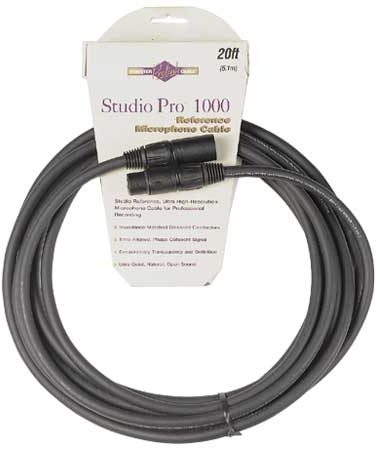
Monster Cable Studio Pro 1000 Microphone Cable
No longer available at zZounds
zZounds Gear Experts Say...
Studio grade ultra high resolution microphone cable for recording and critical performance applications.
Overview
This cable offers 3 Time Correct multiple gauge wire networks for extreme accuracy in imaging, depth, and soundstage, as well as Bandwidth construction for controlled impedance and optimum signal transfer. A Microfiber dielectric reduces high-frequency loss and increases transient response time. Multitwist construction with dense 97% copper braided shielding reduces the effects of EMI and RFI interference. Ohter features include carbon-infused polymer for minimization of handling and vibration noise, and heavy-duty Black Neutrik XLRs with 24k hard gold contacts.
Balanced Bandwidth Design
This technology combines Time Correct windings with the use of selected multiple-gauged constructions to pass the music in correct amplitude and phase. Monster's balanced design interconnect cables use equal conductors for the positive and negative conductors with a passive "ground" shield. The positive signal must be identical to the negative signal, electrically and magnetically, otherwise there will be an imbalance, causing a resultant signal that is a distortion of the original waveform. That is why coaxial cables, commonly used in low cost interconnects (and some high priced ones also), cannot be correctly time compensated and will always be inaccurate.
The results of distortions in wire are audible because in the analog world, we directly hear the electrical signals transferred to vibrations in the air. These vibrations reach our eardrums, which send the signals to our brain, where we… read more interpret them as music. Any distortions in this chain are correctly and accurately detected in our ability to hear variations in frequency and time, which relates to our perceptions of music, harmonic overtones, directionality, dimensionality, and space. Monster's Bandwidth Balanced constructions overcome most of these distortions (no wire is perfect) in a way that no other cable can. It's obvious that regardless of the purity of the material used (they have evaluated all the various LCOFC, OCC, six 9's copper, etc.), one must still overcome amplitude and time domain distortions to achieve accurate sound reproduction.
Time Correct Windings
While effective in lower cost cables, Amplitude Balanced construction does not complete the whole picture. Time domain distortions can be improved, but cannot be accurately controlled to give us the sonic attributes that are related to phase as described earlier. In interconnect cables Monster corrects these time domain distortions by creating a longer path and higher impedances for the higher frequencies. They cannot speed up the lows, so they must delay the highs. By winding the high frequency conductors to create inductance at those frequencies, we delay them in time to pass through the cable at the same time with the slower lower frequencies. This develops the ability to capture lost phase-related information such as dimensionality, soundstage, imaging, and depth.
MicroFiber Dielectric
Since much of an audio signal passes through the magnetic field surrounding the conductor, the quality of dielectric plays an extremely important part in cable construction.
The dielectric affects a cable in 2 ways: the quality of insulation between the positive and negative conductor, and the isolation of the groupings of multiple strands (and in our case multiple gauges) of wire in the same conductor.
MicroFiber, which is Monster's patented design of wrapping a wire strand (or group of wire strands) with a dielectric comprised of 30% air (the best dielectric of all except for a vacuum), has superior characteristics in the area of low energy storage and energy loss. Energy in this case meaning all the components of an audio signal in terms of its electrical, magnetic, electrostatic, and current transfer components.
MicroFiber is used in Monster's cables to isolate individual networks in the same conductor. The result is a music signal that is very fast in its transient and dynamics, which is important in today's music.
Listen to the difference between Interlink Reference 2 (with MicroFiber on the bass and mid bass networks, but not the high frequency networks) vs. the M1000 Mk III, which has MicroFiber on all 3 cable networks. The rest of the construction is virtually identical. The M1000 has all the detail and depth of the Interlink Reference 2, but with better control over the top end and less high frequency smear. Of course the cost of the M1000 is higher. Also audible is the difference between Monster's older Interlink 4 vs. Interlink 400. The only difference between the 2 is that Interlink 4 uses a varnish dielectric (as used in Litz wire) and the Interlink 400 uses MicroFiber.
A further test of MicroFiber is to listen to the increase in clarity and detail, as well as extended frequency response (because of the isolation between multiple-gauged conductors), between Interlink 400 and Interlink 401 (again, the only difference in the conductors is that Interlink 401 does not have Microfiber). read less
Balanced Bandwidth Design
This technology combines Time Correct windings with the use of selected multiple-gauged constructions to pass the music in correct amplitude and phase. Monster's balanced design interconnect cables use equal conductors for the positive and negative conductors with a passive "ground" shield. The positive signal must be identical to the negative signal, electrically and magnetically, otherwise there will be an imbalance, causing a resultant signal that is a distortion of the original waveform. That is why coaxial cables, commonly used in low cost interconnects (and some high priced ones also), cannot be correctly time compensated and will always be inaccurate.
The results of distortions in wire are audible because in the analog world, we directly hear the electrical signals transferred to vibrations in the air. These vibrations reach our eardrums, which send the signals to our brain, where we… read more interpret them as music. Any distortions in this chain are correctly and accurately detected in our ability to hear variations in frequency and time, which relates to our perceptions of music, harmonic overtones, directionality, dimensionality, and space. Monster's Bandwidth Balanced constructions overcome most of these distortions (no wire is perfect) in a way that no other cable can. It's obvious that regardless of the purity of the material used (they have evaluated all the various LCOFC, OCC, six 9's copper, etc.), one must still overcome amplitude and time domain distortions to achieve accurate sound reproduction.
Time Correct Windings
While effective in lower cost cables, Amplitude Balanced construction does not complete the whole picture. Time domain distortions can be improved, but cannot be accurately controlled to give us the sonic attributes that are related to phase as described earlier. In interconnect cables Monster corrects these time domain distortions by creating a longer path and higher impedances for the higher frequencies. They cannot speed up the lows, so they must delay the highs. By winding the high frequency conductors to create inductance at those frequencies, we delay them in time to pass through the cable at the same time with the slower lower frequencies. This develops the ability to capture lost phase-related information such as dimensionality, soundstage, imaging, and depth.
MicroFiber Dielectric
Since much of an audio signal passes through the magnetic field surrounding the conductor, the quality of dielectric plays an extremely important part in cable construction.
The dielectric affects a cable in 2 ways: the quality of insulation between the positive and negative conductor, and the isolation of the groupings of multiple strands (and in our case multiple gauges) of wire in the same conductor.
MicroFiber, which is Monster's patented design of wrapping a wire strand (or group of wire strands) with a dielectric comprised of 30% air (the best dielectric of all except for a vacuum), has superior characteristics in the area of low energy storage and energy loss. Energy in this case meaning all the components of an audio signal in terms of its electrical, magnetic, electrostatic, and current transfer components.
MicroFiber is used in Monster's cables to isolate individual networks in the same conductor. The result is a music signal that is very fast in its transient and dynamics, which is important in today's music.
Listen to the difference between Interlink Reference 2 (with MicroFiber on the bass and mid bass networks, but not the high frequency networks) vs. the M1000 Mk III, which has MicroFiber on all 3 cable networks. The rest of the construction is virtually identical. The M1000 has all the detail and depth of the Interlink Reference 2, but with better control over the top end and less high frequency smear. Of course the cost of the M1000 is higher. Also audible is the difference between Monster's older Interlink 4 vs. Interlink 400. The only difference between the 2 is that Interlink 4 uses a varnish dielectric (as used in Litz wire) and the Interlink 400 uses MicroFiber.
A further test of MicroFiber is to listen to the increase in clarity and detail, as well as extended frequency response (because of the isolation between multiple-gauged conductors), between Interlink 400 and Interlink 401 (again, the only difference in the conductors is that Interlink 401 does not have Microfiber). read less
Reviews
Reviewers gave this product an overall rating of 5 out of 5 stars.
(11 ratings)
Submitted April 5, 2006 by a customer from sbcglobal.net
Monster Pro 1000 XLR Customer Review
I use mine regularly. BLUE makes some fine cables too, but this one is the big daddy.
Sound
There is a difference in quality, especially where demanding digital recording in concerned. If you're using a $100 condenser in the first place, then you probably won't need this. But if you've invested in a decent quality mic, not just any cable will do.
Ease of Use
Duh.
Quality
This is premium construction here. The quality of the signal you send is only as good as your cable, and this one, again, is top of the line. If you are doing non crucial recording, then this is overkill. However, if you take your recording seriously, you can't go wrong here.
Value
OK, so it is a boat load of cash to spend on a mic cable. You get what you pay for.
Musical Background:
songwriter, active musician, home studio owner, formerly in radio broadcasting
Musical Style:
some rock, some acoustic country
2 of 2 people (100%) people found this review helpful. Did you?
Thanks for your opinion!
No longer available at zZounds
In most cases, a product is unavailable because it has been discontinued by the manufacturer

This is a carousel with product cards. Use the previous and next buttons to navigate.
People who bought this item also bought

JBL EON715 Powered Loudspeaker
$599.00
- 12 payments of$49.92/mo
- No Credit Check6 payments of$99.83/mo
-

Shure SM7B Dynamic Cardioid Studio Vocal Microphone
$439.00
- 8 payments of$54.88/mo
- No Credit Check6 payments of$73.17/mo
-

QSC K12.2 Powered Loudspeaker (2000 Watts, 1x12")
$899.99
- 12 payments of$75.00/mo
- No Credit Check6 payments of$150.00/mo
-


Electro-Voice ZLX-15P-G2 Powered Loudspeaker (1x15")
$649.00
- 12 payments of$54.08/mo
- No Credit Check6 payments of$108.17/mo
-

Alto Professional TS415 Powered Speaker
$449.00
- 8 payments of$56.13/mo
- No Credit Check6 payments of$74.83/mo
-


Electro-Voice EKX-15P Powered Speaker (1500 Watts, 1x15")
$1,049.00
- 12 payments of$87.42/mo
- No Credit Check6 payments of$174.83/mo
-
Shure BLX288/PG58 Dual Handheld Wireless PG58 Microphone System
$659.00
- 12 payments of$54.92/mo
- No Credit Check6 payments of$109.83/mo
-