
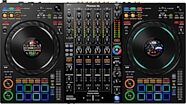
Pioneer DJ DDJ-FLX10 DJ Controller
Whether you're spinning in Serato or Rekordbox, this four-channel controller will get the party moving with innovative track separation and DMX integration.
Comes in 2 Colors
$1,729.00
- 12 payments of$144.08/mo
Overall User Ratings (based on 2 ratings)
Submitted June 2, 2025 by a customer from gmail.com
"A Flawless Upgrade That Exceeded All Expectations!"
Verified Customer
zZounds has verified that this reviewer made a purchase from us.
I've owned this DJ controller for almost a year now, and I can confidently say it has exceeded all my expectations. My journey to this controller wasn't smooth, though. I previously had a Denon SC Live 2, which, to be frank, was a constant source of frustration; it was always crashing and giving me issues. This new controller, however, has been a complete breath of fresh air. I've never had a single problem with it. It's incredibly stable, reliable, and performs flawlessly every single time.To top it all off, the shipping was phenomenal! I was lucky enough that FedEx handled the delivery, and everything arrived quickly and in perfect condition (thankfully not UPS, haha). If you're in the market for a dependable, high-performing DJ controller that won't let you down, I highly recommend this product.
91 of 95 people (96%) people found this review helpful. Did you?
Thanks for your opinion!
Submitted October 27, 2025 by a customer from gmail.com
"Absolutely Amazing"
Verified Purchaser
zZounds has verified that this reviewer purchased this specific product from us.
I have owned the DDJ100, I own the GRV6, and now I own the FLX10. So my review will be a comparison of these units. I'm hoping that this review will help the DJ's on the fence about this unit make their own decisions.Okay so let's start with the 1000 vs the 10. The 10 is basically the same layout as the 1000. So DJ's that have used the 1000 will probably feel just at home as I did when I first got my hands on the unit. I felt very comfortable with this instrument pretty much right away, but I did notice some differences right away. The first thing I noticed was the soundcard. This unit pumps a very nice hot signal, and I'll be honest that's it's been so long since I've had the 1000, but I feel like it's sounds better than I remember my 1000. Which to means that hot signal coming out of my board needs less gain. The result for me was that every mix sounds cleaner and more precise because I have to turn everything down to achieve the SPL levels. Now let's talk about the channel faders. The channel faders feel like they have more weight than I remember the 1000 having. I like that because I have more precision in my volume control. The Magvel fader is light years ahead of the 1000's, but it's one of those things that you have to feel to really understand. I doubt you'll be disappointed. The Track Separation didn't exits with the 1000. So I will compare that in the next paragraph when I talk about the GRV6 comparison. Now I do know that you can MIDI map the 1000 for Track Separation, and I've never have seen how that works, but what I can say is that the Track Separation is very intuitive on the 10. Way more intuitive than I realized it would be than I expected. I think some of that for me was based on my experience with the GRV6.The GRV6 is also a great piece of kit as well, but it's very much in the middle ground between the 1000 and the 10. So I went from owning the 1000 to have no gear for a bit. When I got things straightened out I bought a Numark MixPro, and then I bought the GRV6 because I just feel more comfortable on the Pioneer equipment layout. I bought the GRV6 so I could learn how to use the Track Separation on a board that has native buttons for that. I was happy with the GRV6. The Groove circuit I found very limited and gimmicky after about maybe 2 hours. I played around with it using Serato, but I just don't like that program, and I just didn't feel comfortable playing with Serato. So let's get into it. The Track Separation doesn't sound very good on the GRV6. It sounds pretty good on the FLX10. Perhaps it's the soundcard. I bring this up because there's a big significance in the soundcards. I had to pump every gain up pretty high on the GRV6 for it to be playable. I have to turn down every gain with the FLX10 in order to achieve the same SPL. So automatically everything sounds cleaner. The pad buttons are the next thing that really stand out to me. I do like that the pad mode buttons are placed just like the new CDJ's, but that actually changes my muscle memory from pretty much every unit I've ever used since switching from vinyl to cd's to modern day. That's not really a big deal for me, but the way the buttons respond is crucial. The GRV6 is basically garbage. Sometimes they respond like you want, but usually they have garbage in there response. The Tempo faders are way too short on the GRV6. Very annoyingly so. The nice long tempo faders are always better. This matters way more as you get into the larger BPM tempo ranges, but it's a very real thing when you're trying to make minor BPM tweaks.Basically what I'm saying is that this unit is wonderfully fun to jam out on. I have more fun on this than I ever did on the GRV6 or the 1000, and I find myself being able to pull off mixes and creations that I never thought of before. The best part is that I'm doing this while it all feels natural.I highly recommend this gear.
12 of 13 people (92%) people found this review helpful. Did you?
Thanks for your opinion!
Please wait.