
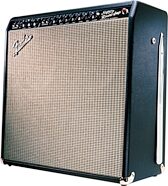
Fender '65 Super Reverb Vintage Reissue Guitar Combo Amplifier (40 Watts, 4x10")
A reissue of a '60s classic, this all-tube amp pushes 45 watts through 4x10" Jensen Alnico speakers with sweet tube-driven spring reverb and vibrato effects.
$2,299.99
- 12 payments of$191.67/mo
Overall User Ratings (based on 92 ratings)
Submitted May 10, 2015 by JERRY L in BERTHOUD, CO
"GREAT AMP !!!! GREAT TONES !!!! LOVE THIS AMP !!!! "
Verified Purchaser
zZounds has verified that this reviewer purchased this specific product from us.
I was looking for something to replace my Fender Dual Showman I was suggested that I try one of these. I was greeted by a very full, clean sounding amp. with plenty of stage volume. Plays very well and looks very cool on stage as well. I LIKED THIS AMP SO WELL I BOUGHT A SECOND ONE !!!
Sound
Very clean, has more than enough volume to fill the stage, Full sounding amp with lots of punch, the 4-10 Jensen P10R give this amp a nice full sound that is an advatage over single and dual speaker amps
Features
Love the Reverb but still Prefer my 1962 Fender Reverb tank when playing Surf also like the Vibrato channel as well,
Ease of Use
Very easy for me I play alot of Surf and instrumentals, easy to use with my other products as well, as for learning curve this amp is as easy as it gets
Quality
The Amp seems to be made very well hopefully without a doubt if this amp is built like the old ones should outlast me LOL
Value
Well we would all like to see the products that we buy for less. But when something this fun and great sounding comes along we forget about that factor and just buy it as I did
Manufacturer Support
Have never had to contact Fender with this amp have had to with a Fender 1994 " Red Knob Twin " back in the 1990's and they resolved the problem with that amp very fast and good service
The Wow Factor
I am very WOW I'd by this amp Due to that it won't break my back everytime I gotta play a show My dual Showman weighed in at 80 lbs. on the speaker cab and 40 lbs on the head so the Super reverb is also a back saver too at just 65lbs.
Musical Background:
PLAYING FOR 30+ YEARS, SEMI PRO
Musical Style:
INSTRUMENTAL SURF ROCK
36 of 38 people (95%) people found this review helpful. Did you?
Thanks for your opinion!
Submitted December 19, 2017 by Jerry L in Platteville, CO
"LOVED THE FIRST ONE SO MUCH I BOUGHT A SECOND "
Verified Purchaser
zZounds has verified that this reviewer purchased this specific product from us.
This is my second Reissue I have owned the first one for quite sometime now I will say the "Groove Tubes" 6L6GE really sound Great in this amp. and give it the classic 60's sound. The first amp I ordered has done well on the road. The only thing I added and would like to see Fender add to this amp in the future is casters making it easier to wheel around other than that plenty of stage volume by itself or roll back and mike up in the mix
Sound
Just like the original as the speakers break in they get even better, however even though no longer in production I have a set of 4 JBL D110 speakers that I pop into my other Super Reverb and boy talk about full rich and responsive. However I would really like to see Fender equip these with Groove Tubes 6L6GE's as standard just like the originals. the 2 Guitars I play are the 1962 fender Jaguar and a 1962 Fender Stratocaster with Seymore Duncan SSL6 pickups both guitars sound incredible through this amp I love the Factory installed reverb But Being a Surf Guy I Have to have my Good ole Fender Tube Driven Portable Reverb Unit PR 263
Features
This is a great Clean amp you can use for Surf, Jazz, Country, and with your favorite effects pedal Rock and get some distortion sounds going
Ease of Use
Cant get much easier
Quality
The other reissue I own has been on the road well over 2 years now and still in great shape has handled the rigors of the road well
Value
Excellent value anytime you buy an amp that goes trouble free on the road for 2 1/2 years speaks for itself
Manufacturer Support
Well I would like to say I have however I have not had one issue in 2yrs and 6m with my first reissue so I think the build speaks for itself
The Wow Factor
Love the look of the amp just screams retro and sounds just as good as the original
Musical Background:
PLAYING FOR 30+ YEARS, SEMI PRO
Musical Style:
INSTRUMENTAL SURF ROCK
16 of 17 people (94%) people found this review helpful. Did you?
Thanks for your opinion!
Submitted December 13, 2008 by a customer from hotmail.com
"The sound I like"
I love the sound and durability. The tube problems are a minor inconvience.
Sound
For me this amp has that rich soulful sound I love. I play blues and the clean sound with a exelent reverb is something I look for in any amp I buy.
Ease of Use
I have played Fender Amps most of my life so the controls were vary familure.
Quality
I have had some problems with the stock 12AX7 tubes.
Musical Background:
Active Musician
Musical Style:
Blues, ock
36 of 41 people (88%) people found this review helpful. Did you?
Thanks for your opinion!
Submitted May 16, 2009 by a customer from iowatelecom.net
"I am a very proud and happy owner of a very great amp,If you've never played thru one,give it a try.You'll be impressed."
The only way would be to buy another Super Reverb.
Sound
It has a very clean sound,great for the 50's and 60's sounds like surf music.
Features
It came with the footswitch which was standard,but the cover was thrown in with the purchase.
Ease of Use
This is a very versital amp,you can play any style of music thru it with no limitations.
Value
It is very much worth the price.
Manufacturer Support
I have never had any warranty issues or had to deal with the company.
The Wow Factor
I would give this product the highest of marks.
Musical Background:
Played in a band 23 yrs. now I play as a hobby
Musical Style:
50-60's Rock,country and some blues
23 of 29 people (79%) people found this review helpful. Did you?
Thanks for your opinion!
Submitted February 19, 2026 by a customer from gmail.com
"Super Reverb 4x10"
Verified Customer
zZounds has verified that this reviewer made a purchase from us.
I'm an old dude from the 60's. I want this amp, seems a little pricey, but nothing makes a guitar sound like these 4x10's. Thank you Fender for bringing it back!
Did you find this review helpful?
Thanks for your opinion!
Submitted June 5, 2003 by a customer from yahoo.com
"A faithful re-creation of an oldie that combines the old with the new!"
1980 saw a brief return to the blackface cosmetics on most models. Super Reverbs produced from 1980 to 1982 had a black face plate with white labels and silver-sparkle grill cloth. By 1983 the Silverface amps as well as the other Blackface ones made in the mid-'60s were all put out of production, the new management team who owned Fender today decided to cut back existing inventory and finally close the Fullerton factories in 1984, after 38 long years of active service. By far points the '65 Super Reverb re-issue combines the old with the new, as most of its essential features are lovely recreated, guaranteed to please all the vintage enthousiasts worldwide!
Sound
This faithful recreation of an oldie such as this legendary '65 Super Reverb re-issue amp has all the soulful features found on most built-in reverb and tremolo-effect Fender amps made in the mid-'60s: cool dark reverb and good old vintage tone! Although the late '70s models (with 100 and 135W respectively) feature a master volume/pull boost switch and a midrange control in the Normal channel for more flexibility, this '65 re-issue beefs it up with 40W of maximal power and a 4x10 speaker chassis coupled with the typical AB763 scheme.
Features
Sonically, the '65 Super Reverb suffers of some weaknesses, especially due to the absence of a midrange control knob in the Normal channel and the fact that it had only 40W RMS, as the BF Super Reverbs made from 1963 to 1968 (and the SF models made from the end of 1968 to the beginning of 1975) are usually referred as "non-master" amplifiers, i.e. they don't have a master volume control knob between the "pilot red jewel light" and the intensity control. But it isn't any for the Silverface Supers too: CBS switched to the infamous AC568 "silverface" circuit and removed the classic "tail" outlining from the Fender amp logos in 1972 for the rest of the line, as the new "tailless" style first appeared in 1967 with the ubiquitous Bronco amplifier (a sort of VibroChamp clone with bright red labels on the shiny silver-nickel faceplate instead of the more conventional light blue ones). Otherwise, it's a pretty good amplifier and suits perfectly any kind of music styles, from the funky surf craze of the '60s to the classic '50s/'60s rockabilly/blues/rock period.
Quality
Excellent!
Value
An excellent addition to the increasingly popular Vintage Re-issue series of American-made Fender electric guitar amps, as the Mexican factory soon take care of the Silverface amp production (Blackface amps still fare the principal object for the Corona facility's production staff).
Manufacturer Support
Can't have a particular support with Fender's guys about this good old vintage amplifier yet, although there's now an obviously serious move for Fender itself to make and develop Silverface re-issues (due hopefully to the success that followed the introduction of the Vintage Re-issue series of guitars and amps in 1982) at Ensenada, Baja California, Mexico, as some of the Classic Series re-issue series of guitars, such as the '70s Stratocaster, the '69 and twin-humbucker '72 Tele Thinlines, as well as the '72 Tele Custom, popularized by the Rolling Stones' guitarist Keith Richards, are assembled and manufactured at the Mexican state-of-the-art facility.
The Wow Factor
Whether use a Blackface or Silverface version, you'll soon notice the distinct major differences between a BF and a SF Super Reverb. They share the same black tolex indeed, but they used two different types of circuit schemes: the Blackface version has the much-beloved AB763 scheme while the Silverface features the infamous AC568 circuit, giving to the Silverface line a fairly bad reputation. Also, some Silverface Super Reverbs had respectively 100 and 135W RMS of power on most models, featuring a tailless logo and sporting a master volume/pull boost switch and a 3-band EQ in the Normal channel.
Musical Style:
Various styles
30 of 66 people (45%) people found this review helpful. Did you?
Thanks for your opinion!
Submitted June 9, 2012 by Thomas Vardy
"Yet another bad fender product!!!!"
Verified Purchaser
zZounds has verified that this reviewer purchased this specific product from us.
I have been a long time player of Fender products, over 25 years. I have had some great guitars and amps. I just bought a brand new 65 super reverb from ZZSOUNDS
to replace my tweed blues Jr that failed way before its time. I have written off a Mexico Fender products, so I bought a USA made amp. It has a great sound but the reverb feeds back real bad and after a hour or so it starts to crack and pop and progressively gets worse.Yes it has a 5 year warranty but I bought a new amp not something that needs work. Going to reach out to Zzounds and Fender. I have bought and sold and traded many Fender guitars and amps over the years and the only ones worth keeping are pre 1995 guitars USA and Fender Japan all years. The older amps seem to be better. Although I had a reissue Bassman that was great I regret getting rid of it. Hopefully mine was just a rare instance and Fender will sort it. All and all Zzounds has been good to deal with and will purchase from them again.
Musical Background:
28 years active guitar player.
Musical Style:
Surf, rock, alt country
12 of 30 people (40%) people found this review helpful. Did you?
Thanks for your opinion!
Please wait.