

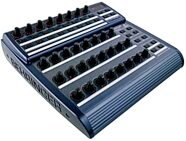
Behringer BCR2000 MIDI Controller with Rotary Knobs
Playing software synths? Stop trying to mouse knobs on your screen -- wrap your fingers around 32 sturdy illuminated knobs on this MIDI rotary controller.
Overall User Ratings (based on 29 ratings)
Submitted May 2, 2008 by a customer from timexile.com
"The 303 of today"
My intention is to stock up on a number of these and a wind turbine before we run out of oil and hell breaks loose. I will then flee to the hills and live in my straw bale house where I will program my own hands on improvisation/composing tool based entirely on these units, a lappy running reaktor, some keys and some pads... and some nice acoustic instruments... and mics... and good friends... and chickens, seeds, hand tools, workbench etc etc. These units are part of my vision for the future. The 303 of today.
Sound
Sound as FAQ
Features
The 2-way control implementation is is beyond reproach. If you're into patch building in reaktor/supercollider/max etc and you want to create your own context sensitive hardware control experience, there's nothing else around that does it at anywhere near this price range. Controller values are set and stored when the unit receives the MIDI signal for the relevant knob, the LEDs update properly and the values are stored. Even duplicated controls are linked together within the machine. It's totally unique in this respect. My M-Audio Project Mix is put to shame by this.
Ease of Use
Obviously the limited screen is hard to work with when programming it but they've done the best they could given the spec. The better alternative is to use the non-Behringer freeware BCREDIT app which is basic in terms of GUI and workflow but to the point, and also allows you to use some of the RHS buttons which usually remained locked when programming on the unit itself. Actually jamming with it is tops... the knobs are well spaced and the visual feedback is excellent. My only minor complaints are that the knob range is set to 360deg by default which isn't quite like non-rotary pots which are more like 300deg (it just means that getting the full sweep with a continuous movement isn't as easy), and that the knobs wobble a bit... but which ones don;t in this price range?
Quality
I haven't gigged with them yet as I'm still building a machine which uses them. I'm imagining it will last longer than my Korg MicroKontrol did (which died after 9 months), but not as long as my Evolution UC16 (which has been checked into the aircraft hold regularly since 2003 and hasn't coughed yet). But only time will tell. I've already snapped off one of the pots when it fell 3ft from my table to the floor and this one poor pot took the whole weight on its chin. I've also heard tales from other musicians that the knobs are prone to snapping. I made one attempt at fixing it with the wrong glue which didn't work but I reckon a bit of superglue will do the trick.
Value
Probably better value than a free lunch. Even more so as there is such a thing as it.
Manufacturer Support
Asked about 2-way communication before I bought it and they took a week or so to get back but gave me a knowledgable answer.
The Wow Factor
For nerds this is like a peak up the skirt of perfection
Musical Background:
gigging & recording full time for 3 years
Musical Style:
Britten meets Scott Walker meets AFX meets me
31 of 33 people (94%) people found this review helpful. Did you?
Thanks for your opinion!
Submitted September 6, 2004 by a customer from hotmail.com
"I would buy 2 of these before I ever consider getting another MIDI controller again period..!"
This review has been selected by our experts as particularly helpful.
If this ever was stolen or broken I would replace it with the same one! I will be using this product with every thing I do in the studio. And I was looking at the Novation Remote25, but thats a rip off period! And the Evolution "knob box" (whatever) feels like a toys r us toy! I would buy 2 off these before I ever consider getting another MIDI controller again period..!
Sound
It has no sounds...
Features
The features are great, Storing presets is easy, and presets are easy to program!
Quality
I have never used "BEHRINGER" products before. But I might just buy another one of these because it feels solid, and there is nothing that could go wrong with a simple and easy to use unit like this..
Value
Great, if you use soft\hard synths you will love this unit, and it is the best value out there peroid for a midi controller!
Manufacturer Support
I gave them a 9 because I have not needed to talk with a "BEHRINGER" rep because I have had no problems, But the have already updated there MIDI drivers for this product!, And the F model support Emagic, and DigiDesigns, Steinberg..!
The Wow Factor
This is petty, but I wish the LCD would be a bit more modern, but who cares when you get a product like this with the total control you can program into it!
Musical Background:
musician, paid sound designer
Musical Style:
electronic (industrial)
10 of 11 people (91%) people found this review helpful. Did you?
Thanks for your opinion!
Submitted May 7, 2005 by a customer from yahoo.com
"Flexible, great value, and Reason 3.0 *loves* it"
Verified Customer
zZounds has verified that this reviewer made a purchase from us.
I'd like for the knobs to have detents ("clicks" you can feel as you turn the knob-- as on a mouse's scroll wheel) so I can know the exact number of increments or decrements I'm giving a parameter without looking continuously at the board, but it's a minor complaint.
If you're using a keyboard and mouse right now to control your DAW or softsynths, this thing will change the way you make your music. By breaking parameters out to knobs, you get back the hardware feel to things-- you can even change multiple parameters at once. If the MIDI host you control sends parameters back to your board (Cubase, Reason, and others do this), you don't even have to look at your screen to do your work most of the time. This lets you focus more on the task at hand-- making music-- and less on getting your mouse to move parameters one-at-a-time.
This is a ridiculously small price to pay for such a useful tool. Just buy it. You won't want to let it go.
Features
The BCR-2000 is just a board with knobs and buttons, each assignable to any MIDI controller message you can imagine, including NRPNs, pitch bend, MMC messages-- you can even program the buttons for note on/note off messages. The great thing about the BCR-2000 is you can set up each knob or button with different modes.
For example, a button can turn a note on and off with each button press, or it can just keep it on for the time you depress the button. Great for triggering momentary loops and samples. The knobs can be set up for different value ranges and to report their current values in diferent ways using the LEDs around them. Knob value ranges are customizable too.
Quality
I'll be honest with you-- when it's off, this board has a plastic look to it. I throw this thing into my backpack when going to jam sessions-- not the smartest way to tote it, but I'm careful to pad it (most of the time...). I brought it home one time and one of the panels had popped slightly out of place, but it popped right back in.
You'll hit these issues with any controller in this price range, but this thing has an advantage over the toy look and feel that Evolution/M-Audio controllers have.
Value
My first choice was a Mackie Control Universal, costing almost 10 times as much. But then I saw the fader version (BCF-2000) of this box, which only lacked per-channel parameter labeling. I decided I wanted more knobs to control softsynths and would be able to use this for more than just mixing and setting levels. It's small enough to throw into a back pack (don't forget to pad it with neoprene or even a towel), and it's so configurable you can use it for just about anything.
Did I mention there's a USB-MIDI interface on board, the power-supply is built-in (no wall-wart), and it comes with a USB cable (colored Behringer blue) so you can hook it up right out of the box? I'm glad I bought this, and I will buy the fader version if the Mackie doesn't add USB to the Control Universal soon.
Manufacturer Support
Haven't had to touch 'em. I recommend reading the manual if you run into trouble; it's very helpful and explains any behavior you might find quirky.
The Wow Factor
When you turn it on and the LED rings light up, the whole look changes-- it's "cool." And if you're in a darkened room (at a gig, party, etc.), you'll get oooh's and ahhh's. Yes, the device itself will attract its own audience-- just make sure your performance lives up to it ;-).
Musical Background:
Hobbyist
Musical Style:
Electronic, Dance
7 of 8 people (88%) people found this review helpful. Did you?
Thanks for your opinion!
Submitted April 2, 2005 by a customer from yahoo.com
"Cant touch this. Or... I guess that is the idea. I am master of my studio universe, the Wizard of Oz behind the curtain, with my"
Can't imagine getting rid of my BCR2K and BCF2K now... I am master of everything in my studio with these at my fingertips. I used to be a DIGI 002 user, and was nervous about getting rid of it, but I have basically the same control now with these very inexpensive units (obviously aside from the audio ins&outs of the DIGI, which I just use an MBox for now), and have the flexibility to control both ProTools and Cubase and other programs, not just ProTools now.
Sound
Of course this doesn't have any sound... it just controls things, which it does very well.
Features
Lots O' Knobs & buttons.
Quality
I know Behringer quality can be spotty sometimes (I had problems with their digital mixer) but no complaints here... everything works great out of the box, and the plastic case is sturdy and well engineered.
Value
Can't touch this. You can pay more for another brand, but I'm not sure why you'd want to. Works fine at an amazing price, is easy to use, seems to be reliable, and very versatile.
Manufacturer Support
I had to use their support for another problem recently (not with the BCR2000 or BCF2000) and they lagged a couple of days in responding, but nailed the problem first time, and were a great help.
The Wow Factor
Maybe not 'sexy' exactly, but one of the most useful purchases I've made for my studio for quite awhile.
Musical Background:
recording musician
Musical Style:
eclectic
1 of 1 people (100%) people found this review helpful. Did you?
Thanks for your opinion!
Submitted January 5, 2006 by a customer from gmail.com
"BCF-2000, I love you."
No regrets, makes my life within reason hella-easy. I love you, BCF-2000.
Sound
It... doesn't... make... sound...
Features
I'm using the BCF with Reason 3, and it interfaces INSTANTLY with every virtual hardware component, which is wonderful. I only wish it had LCD displays for each channel so I knew which was being controlled by what. But for the cost, you couldn't ask for more.
Quality
Seems like a very sturdy piece. Faders are a solid 10cm long, feel as sturdy as those I work with every day in professional situations, and the fader automation is extremely precise.
Value
Automated faders for 200 bucks, incredible. Not to mention countless other fully assignable controls. Value takes all in this contest.
Manufacturer Support
Again, this piece interfaces with most popular audio software, but I had a hard time finding comprehensive lists of parameter controls for Reason itself.
The Wow Factor
It's great. It's not gorgeous, but it's great. It's sturdy. I don't see how you could regret a buy like this.
Musical Background:
Lifelong musician, live sound engineer, composer, sound designer.
Musical Style:
Love
Did you find this review helpful?
Thanks for your opinion!
Submitted August 6, 2007 by a customer from verizon.net
"Try It You'll Love It!"
Verified Customer
zZounds has verified that this reviewer made a purchase from us.
I hope for quite awhile,money is not the easiest commodity in my life sometimes.
Features
Apparently total control of software via assignable encoders and buttons including MIDI keyboards,sequencers and it works for digital editing of video as well.
Ease of Use
This is a little annoying,there are a slew of presets,you got a LED readout,numerical,and little description or clue what the numbers are(the manual is too skimpy) some lead one to think note values etc(B3,E4, then theres the wiley H14,whatever the hell it is,weight,height of duration?),without a keyboardwill probably never know what some are.I use Cakewalk withit and AbletonLite and havent detected what many settings are.The factory is going to send deeper documentation on these.
Quality
Seems prety good to me for the money.Beats the hell outa chasing things around with a mouse and the compuer shortcut keys.It is a tool so sense tells to treat it with respect and not abusively,you have to with the plastic case,but with its design an easy to biuld wood box could easily be fabricated to go around it.My XP Pro couldnt open the firmware update for it( an enhancing mechanism? of sorts)and they are in Beta of their own Java mixer for use with it(a freebie to owners).
Value
Rip snorter
Manufacturer Support
As stated above support looks descent if they follow thru their top notch.I want more info on its settings etc.
The Wow Factor
It does arouse me,even if I preffer slider to nobs,usually.
Musical Style:
groovy
of 4 people (0%) people found this review helpful. Did you?
Thanks for your opinion!
Submitted February 26, 2008
Behringer BCR2000 Surface Customer Review
Features
It does exactly what it's designed to do. You think of it, it can control it (provided the device you want to control allows it.)
I use with Sonar and have found that the tool at Sourceforge http://sourceforge.net/projects/bcr2000control/ is excellent for Sonar and even puts a GUI on your screen to tell you which knob does what!!
Ease of Use
Can be tricky to set up at first and in operation remembering which knob does what is tough. However with
http://sourceforge.net/projects/bcr2000control/ and Sonar this is no longer a problem
Quality
A little too plastic but everything works nicely.
Value
no argumants from me
The Wow Factor
OOOH look at all the pretty lights!
Musical Background:
Ex Pro now hobbyist
Musical Style:
Trance
1 of 1 people (100%) people found this review helpful. Did you?
Thanks for your opinion!
Submitted February 17, 2005
"Best product."
Verified Customer
zZounds has verified that this reviewer made a purchase from us.
I love this thing.
Sound
This thing doesn't make any sounds by itself by it does control sound machines, which it is pretty good at. I judge this by the rate in which it transmits midi data, which is relatively poor. But its great features make up for this
Features
This will let you manipulate MIDI control in just about any imaginable way. I've got mine controlling every parameter of a Logic soft-synth, makeing performance a lot of fun.
The LED rotary knobs are fabulous. They can even respond to incoming midi data. I wish more MIDI control devises, like keyboards, had 'em.
You can also recall presets which is great.
Quality
It's a little flimsy but it's good enough. A couple knobs aren't exactly as smooth as others but they all work.
Value
You can't beat this value. They next step up for a product like this is a $1000+ Mackie.
Manufacturer Support
Don't know.
The Wow Factor
I'm buying another for more control.
of 3 people (0%) people found this review helpful. Did you?
Thanks for your opinion!
Submitted November 5, 2004
Behringer BCR2000 Surface Customer Review
Verified Customer
zZounds has verified that this reviewer made a purchase from us.
Features
Bought it for controling my soft sythn's and sequencer's, only thing i found with led's and endless knobs, which is cool but i figured that i could set up the 20 plus knobs, record some midi and watch the leds move upon play back, so i could remmber what all the paramters of the knobs where. i called up behringer , and i guess only the other two step up models do that, and that might only be with the motorized faders, which i bet dont move too fast if you have some crazy stuff down. i sent it back, would of loved the product if leds refeclted on the set channels data. woudl of made sense too but oh well
Quality
i didnt like the build too much either, it was all right plastic peices , kinda wiggly
Musical Background:
musician
of 2 people (0%) people found this review helpful. Did you?
Thanks for your opinion!
Please wait.