
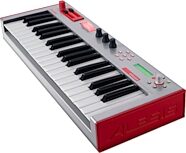
Alesis Micron 37-Key Analog Modeling Synth
8-voice, 4-part multitimbral, holds over 1,000 programs and multi-timbral setups.
Overall User Ratings (based on 85 ratings)
Submitted December 18, 2009 by a customer from gmail.com
"You don't gotta look good to sound good..."
This review has been selected by our experts as particularly helpful.
I'd prolly buy it again if I thrashed it. I do most of my stuff with plugins anymore, but it sounds great and, more importantly, I can get the sounds I want from it. It has about 15 different filter models, and so many routing possibilities that it's nearly a little modular synth. The only synth I've owned (and looking back, I've owned a few) with such comprehensive routing is the Waldorf MicroQ rack. That's a sick little synth, and totally worth the used price these days, but I digress... Lots of routing, lots of filter modules, even decent effects, something that it's big counterpart the Ion lacked (well, at least decent verb and delay... which are key) So yeah. Good work alesis.
Sound
The sound really is impressive. I put it next to my Evolver keyboard, and it holds up. It's beefy and shows very little aliasing. One could wish for more polyphony, but most of the ample processing power of this board goes to ensuring high quality sound.
Features
For such a small synth, this thing has a huge amount of routing and sound processing capabilities. Its unfortunate that there aren't more independent outputs, and more knobs... but hell, it is under $400.
Ease of Use
This thing is a right pain in the ass. Yeah, yeah, yeah... it gets easier as you learn it, and there's a slick method to assigning the 2 sliders/3 knobs available to you, but most of the editing is done through that one little knob on the right side. Ugh. At least there are VST plugins available that give you easy access to all the programming parameters.
Quality
I'm split on this. The aluminum case feel solid, and the knobs have nice action, but the keyboard is pretty spongy. Its not the worst I've felt, and it'll do as a master controller for a mobile setup, but it ain't good. The master controller knob is pretty weak sauce too. I'd hate to bust that off. On the other hand, they did pay attention to details, like actually screwing the in/outs to the case, rather than just relying on the mainboard solder to hold it in place, so its much less likely that it'll develop nasty output crackling in the future. The red sides, while being made of a fine polycarbonate plastic, are ugly as hell. I'd like to mod mine with some wood panels.
Value
I got mine new for about $320. Probably the best $320 I've spent on my studio. These things are being blown out to make room for the Akai MiniAK, which is the same synth engine in a different (slightly better, IMO) body. Get one.
Manufacturer Support
Dunno... Never had to deal with it. Alesis made a good product, so that's worth something, right?
The Wow Factor
It's kinda ugly, and the keys are squishy, but the sound is top notch, and it has a bunch of weird programming extras. Tons of modulation, a loop sequencer and drum kits I'll make the comparison to the microkorg here: The microkorg is basically a 10 year-old synth (the MS-2000) in a little body. It sounds like a 10 year-old VA synth. I owned an MS-2000, and it was fun, and had some pretty neat sequencing capabilities (not sure whether this is in the microkorg or not) but it aliased like a mo-fo and was pretty thin sounding. Now, I know that lately the microkorg has been all the rage with the kiddies, but, well, the micron just sounds so much better. Also the keybed is also micro. Annoying. The microkorg is a bit easier to control, owning to its dedicated knobs, and more comprehensive programming matrix on the top panel, but its not half the synth that the micron is at the end of the day.
On its own, the micron is a powerful, and impressive sounding synth engine in a small form factor. Yeah, corners were cut keeping it cheap, but not in the sound department. Like I said before, I'll probably swap out the plastic end panels (UGLY, IMO) with some custom wood ones. That'd increase the sex-appeal. Wow, did I really say "sex appeal" regarding a synth? I doubt any keyboard would ever get me laid, but putting wood ends on the sides on the sides of this one? Still probably not.
Musical Background:
Hobbyist
Musical Style:
Techno
10 of 10 people (100%) people found this review helpful. Did you?
Thanks for your opinion!
Submitted April 16, 2007 by a customer from temple.edu
"Micron > Microkorg. Not a competition at all."
Verified Purchaser
zZounds has verified that this reviewer purchased this specific product from us.
If you have more money than you know what to do with, it's obvious that there are better synths out there. (Does the name Moog do anything for ya?) For $400-600, however, there is literally nothing better on the market. I will never sell it, even if I upgrade. The sound, the polyphony, the sequencer, the knobs, the two sliders, the pitch bend wheel, the full-sized keys, the alphanumeric display (albeit small), the sturdy build and aluminum housing, the drum machine, the backlit buttons, the ease of use, the portability. It's the best. If you're debating between this and the Microkorg, stop reading and buy the Micron. You won't regret it. Do it today.
Sound
The sounds on the Micron are second to none in its price class. With fat basses, screaming leads, singing sines, really deep pads and old school analog drums, the sounds will definitely impress you. Some of the programs get a tad farty on the low end, but as with most instruments, every sound in this box has its "money" octave(s). Non-musicians will ask me if it's "like... a toy keyboard" before they hear the sounds it produces. The Micron is a little nerd with a huge soulful voice.
Features
The sequencer, drum machine, full sized keys and ample screen put the Alesis Micron head and shoulders above its main competitor, the Microkorg. For a virtual analog keyboard, I couldn't ask for a better feature set. Lots of new instruments try and fail to be the new all-in-one, but for many electronic genres, this synth really can do everything you will need.
Ease of Use
Navigating the Micron can be a bit tedious compared to the more button-laden interfaces of larger workstations. There is a lot of turn - click - turn - turn - click involved to use the sequencer and drum machine, especially. However, everything works and is explained in the manual, so it's worth the small amount of extra time it takes to get the hang of the interface. For example, if I was composing similar sequences, I could record a 4-5 track song on the Micron in about the same time it would take me to do it on my Korg Triton. Maybe a minute longer.
Quality
This keyboard is solid as a rock. I have a good story illustrating this. I was backstage at a show recently where I encountered a Microkorg perching daintily atop a big keyboard amp. I later saw its owner delicately picking it up and slowly sliding it into a gig bag like it was made of glass. Don't get me wrong - we should all treat our instruments with such care and respect. However, if you've held the Microkorg, you know it's somewhat toy-like in its construction. Granted, this "retro toy box" look is a big part of its aesthetic appeal, but the Micron can really take some bumps and knocks in stride due to its aluminum housing. I have beaten the crap out of mine (tossing it onto the bed, letting it fall to the floor, storing it under other equipment, jammed out on it way too hard) and it still looks new. The main navigation knob or click wheel (a term normally reserved for Ipods, I know, but it works the same way) is the one exception to the instrument's otherwise unmatched durability. The sliders and pitch/effects wheel are rubberized and sturdy.
Value
There are drum machines that sell for close to $400. The Micron has dozens of sexy analog drum sounds and an easy to use rhythm sequencer. There are keyboard controllers of a similar size for close to $200. The Micron has full sized keys. There are keyboards that don't sound nearly this good with way fewer instruments and less sound sculpting capability for close to double the price of the Micron. It is the best value in the electronic music world right now.
Manufacturer Support
The best kind of technical support is the kind you do not need. Ever.
The Wow Factor
I thought the Microkorg was the cooler-LOOKING synth until I saw them next to each other in person at Guitar Center. Now I definitely think the Micron is the sexier of the two. Based on looks/physical alone... Microkorg pro's: Wood side panels just like the big boys. Microkorg con's: Cheap looking wood, flimsy sliders and knobs, mini plastic toy keys, lightweight fragile build, tiny number-only display. Micron pro's: Durable oldschool red side panels, rock-solid knobs and sliders, pulsating LED tap tempo button, ample alphanumeric display, metal casing. Micron cons: Heavier.
I need to dedicate an entire new paragraph to the pitch bend/effects wheel. It's a very durable, rubberized spring-loaded wheel (that is, it returns to the center after bending). The coolest feature of the bend wheel - it has an intense red degree-sensitive backlight. That means that the further you bend, the brighter it glows. The pitch bend wheel is definitely the Micron's most aesthetically pleasing physical feature. So sexy, and I didn't even mentioned the backlit navigation buttons.
Musical Background:
Hobbyist, Amateur Producer, Performer
Musical Style:
Electronica, Hip Hop, Pop
65 of 68 people (96%) people found this review helpful. Did you?
Thanks for your opinion!
Submitted January 1, 2012 by a customer from aol.com
"BANG 4 BUCK"
Verified Customer
zZounds has verified that this reviewer made a purchase from us.
Not getting rid of this.
Sound
A lot of flexibility here for a virtual analog: can sound tinkly & metallic like a DX-7, but can definitely go warm and buzzy like a Moog or Prophet. If you're looking for evolving sounds that never get old, this is the ticket. One tip: The middle knob is almost always programmed to add digital noise to your sound. I can think of about 100 better ways to use this knob. When you find a sound you like, that knob is a good candidate for any parameter you'd like to change but can't. As for sounds, this thing does the 80's very nicely. It also does stuff you couldn't think of in the 80's (or 90's, for that matter).
Features
Very, VERY cool arpeggiation, with lots of flexibility. Couldn't be easier to store your favorites--very intuitive after just a little bit of study, and not much time with your nose in the manual. Having a designated tap tempo button without any menus to dig thru makes me want to run my other gear from this little boy. Lots of short-cuts so that when you're programming part of a layer, you can jump back and forth between the combination and that one layer.
Ease of Use
Storing your favorites for performance couldn't be easier. I do wish more of the sounds were more useful 'out of the box'--so many of them need tweaking. On the other hand, the longer I own it, the more I expect this keyboard to reflect my personality and style--less generic, less "oh, I've heard that before". The rhythm programming--and where it fits into building sounds--does take a little tinkering. And you can wish for a more graphic representation of all those cool filters. But at this price point, you've really got to hand it to Alesis.
Quality
Not a toy, tho it looks like one. Pretty solid sliders and knobs. But that big clear knob, which gets used more than any other control on the board, feels pretty flimsy. Nice synth action keyboard. And though it may look like plastic, the case is clearly pretty heavy duty aluminum. The end pieces are plastic, of course. But again, at this price point, it seems pretty rugged. I'm crossing my fingers on that big knob, tho...
Value
37 full size keys, lots o flexibility and awesome sounds, easy programmability, all for $225 (used). I love Korg products, but won't buy the microKorg or any of it's sisters because of the mini-keys. Venom sounds very cool, but I've got fat, phat basses, nasty leads and evocative pads on the Alesis at about two thirds the price.
Manufacturer Support
Haven't had to use them, which is the best I can say about any support department.
The Wow Factor
Depends on whether you like something that looks like a toy. I got it in spite of the looks, but have enjoyed knocking people's socks off when they hear what comes out of it. I don't use the pitch bend that much, so the fact that it lights up brighter the further you turn it is just a plus (or a minus, depending on how macho you need to feel when you're playing).
Musical Background:
35 years playing a little bit of everything and writing songs in my spare time. Made a little money at it, but never a pro.
Musical Style:
Rock, Soul, Blues, Gospel
2 of 2 people (100%) people found this review helpful. Did you?
Thanks for your opinion!
Submitted January 2, 2006 by a customer from mail.com
"Mighty Mouse The Powerhouse!!!"
This review has been selected by our experts as particularly helpful.
I have a Korg MS2000 (Korg Microns Big Brother) and I think it's better than the MS2000 surprizingly. When I first opened the package I thought 'oh man did I make a mistake'. Then I played with it and was shocked to see what this little bugger can do.
Sound
I was skeptical to buy this keyboard due to its size but I needed a small board to accompany my Korg MS200 and my (soon to be) Korg TR Workstation and I must admit that under the hood of the micron is a powerhouse of a machine. The sounds are great. Some are cheezy yet tweakable to your hearts desire and other souns are simply impressive and rich. It's perfect for my style (Ambient & General Electronica).
Features
Sound Engine
_Eight voices of industry-leading analog-modeled sound (8 voice polyphony)
_Three oscillators per voice, with continuously variable wave shapes, sync and FM
_Two multimode filters per voice, with 20 classic and unique filter types
_Three envelopes, two LFOs, and sample and hold per voice
_Twelve-route modulation matrix, with 114 sources and 78 destinations
_One insert drive effect per voice
_Two master effects processors, with reverb and delay
_Full-featured 40-band vocoder
Sequencing
_Programmable pattern sequencer and arpeggiator
_Programmable drum rhythm sequencer
_Realtime or step recording, with controller motion
_Live realtime phrase capture -- one-button record and loop
Setups
_32-part multitimbral -- up to 32 programs per setup
_Up to 26 simultaneous patterns or drum rhythms per setup
_Quick splitting and layering
Presets
_Over 500 preset programs, with space for 400 more
_Over 200 preset pattern sequences and 250 preset drum rhythms, with space for hundreds more
_Fully compatible with Ion programs.
Quality
For it's size it has a very solid construction. The sliders seem a tad flimzy but other than that it seems like a solid little powerhouse and seems to be a trust worthy machine considering it pretty much does everything it's Big Brother the Alesis ION can do. Great little anologue synth.
Value
If your someone looking for Ambient-House-Trance or General Electronica sounds or even Sound Effects; then this little Powerhouse is awsome. If your someone who needs a keyboard to help with Rock, Jazz or Pop your better off in getting a workstation. An inexpensive awsome Workstation is the new Korg TR (61 or 76 key based).
Manufacturer Support
Never really dealt with them on a serious note. I had a couple questions that I emailed them and they responded within 3 days-I think-and answered my basic questions. Other than that I hear that their product knowledge and warranty policy isin't the greatest but that's just from some of my own research from other reviewers. So far Ive owned an Alesis QS7 and this Micron & the customer support for me has been up to par so far-so this review I am basing on my personal experience with Alesis.
The Wow Factor
For its size you cant expect a sexy looking synth. With that in mind for its size and what it can do it looks perfect.
Musical Background:
Keyboardist and Bassist (Software programs as well such as Cubase and Reason)
Musical Style:
Electronica (Rock as well)
1 of 1 people (100%) people found this review helpful. Did you?
Thanks for your opinion!
Submitted April 14, 2005 by a customer from niu.edu
Alesis Micron Synth Customer Review
I don't see myself in the market for another synth for a long time.. I might get a master midi contoller, but nothing with its own sound engine.
Sound
The sound of the Micron is among the best of any VA synth i have come across. The tones sound great when pumped out of my Roland KC-60 40 watt amp, and even better out of PA's. The micron has a lot of moog emulated tones,synth pop sounds, and even industrial basses.
Features
I like the three main parts of this synths interface, and all of them are useful in music making. Programs are all the tones you can play, patterns are more for electro-influenced music, and setups are all of the micron's power rolled into one.
Quality
The quality of this synth is very good. The body, the full sized keys, and all of the knobs except the main knob are super solid. Some have complained about the durability of the main knob, and yes it is weaker than the other knobs. However, if you treat your instruments with care, then this isnt a problem. I have a feeling people really crank on the knob during a stage preform to look "cool". As long as you don't really wrench it, it won't be a problem. Also, i have been carrying it around in my car without any gig bag, and iv'e had no problems. This really is a well built synth.
Value
Compared to its' Korg counterpart, the Micron should be in anyone's studio who wants a great sounding, well built, compact synth with full sized keys. The Micron has 500 onboard programs compared to the MicroKorg's 128, and both retail at the same price of 400 dollars
Manufacturer Support
I have had no problems, but Alesis is friendly company, and their tech support is very accessible.
The Wow Factor
I couldn't think of a more appealing looking synth other than the Clavia nords. The micron doesn't pretend to be a vintage moog, like the MicroKorg does (wood side panels.) It's practical, and good looking.
Musical Background:
First year musician
Musical Style:
Synth Rock/New Wave
2 of 2 people (100%) people found this review helpful. Did you?
Thanks for your opinion!
Submitted March 12, 2009 by a customer from yahoo.com
"ME LIKEY!!!"
Verified Purchaser
zZounds has verified that this reviewer purchased this specific product from us.
Great, great mini synth. If lost, stolen, or damaged, I would immediately replace it with... another Micron, of course! Great addition to my studio, and my life!
Sound
Sounds incredible!!! Big punch for such a small package. Also a great deal of freedom to tweak sounds and make them your own.
Features
It's cute to look at (I'm a girl thus "cute"). Just a couple knobs, and a couple buttons...
Ease of Use
Pretty straight forward. Easy to use. No need to break out the manual. Again, for the price, you can't beat it!
Quality
Well made product, especially for the price. A great addition to any studio.
Value
Can't beat the price for what you're getting. So nice, I'd by it twice!!
Manufacturer Support
Haven't had any problems with it, doubt I ever will. I have other Alesis products and have never had any problems with them either.
The Wow Factor
It's cute. Doesn't look too much like a toy (MicroKorg) to be realistically usable. Nice full size keys. Me likey!
Musical Background:
Active Musician/Songwriter/Arranger
Musical Style:
Pop/Singer-songwriter/R&B
1 of 1 people (100%) people found this review helpful. Did you?
Thanks for your opinion!
Submitted June 23, 2006 by a customer from sbcglobal.net
"For The Dough You Can't Go Wrong!"
Verified Purchaser
zZounds has verified that this reviewer purchased this specific product from us.
This is the only analog synth I want. I use it live for mono mini-Moog leads and horn and string / pads etc. midi'ed with a sample playback module.
Sound
Every thing I wanted.
Features
A computer based editor would be nice. But cheap is why I bought it. If it makes it more expensive, forget it.
Ease of Use
Programing is laborious. No way to key in parameter values. You have to spin the control knob around and around. Also, you can not map progs to another location. Since I wanted to play the Micron with my proteus SE to thicken the brass and sax etc. I had to reprogram the sounds into the apropriate program locations. It took forever but now I just plug and chug.
Quality
I received B-stock and could not find even a smudge. However it feels like someday that control knob might spin right off.
Value
You cant beat it for the dough.
Manufacturer Support
Not yet. And I hope not.
The Wow Factor
It's small. That may not be sexy but it's easy to live with.
Musical Background:
"Weekend" Musician
Musical Style:
Rock
1 of 1 people (100%) people found this review helpful. Did you?
Thanks for your opinion!
Submitted November 22, 2009 by a customer from gmail.com
"Amazingly portable for such a beasty synth engine. The interface is a little lacking but the software editor fixes everything."
Sweet little synth
Portability is a massive plus for gigging!
Sound
Sounds awesome! The most analog sounding virtual analog out there, tied with the nords. It's worth noting that this is one of the only virtual analogs released by a company/design team that had a real analog on the market at the same time (Andromeda).
So many filter choices! This thing is a beast!
Features
Soo many for such a compact unit
Ease of Use
Here's where it gets a bit iffy. It is terrible to edit and most of the presets have terrible parameters assigned to the "soft knobs". I couldn't hook it up to my Evolution knob box because it used NRPN and not the usual CC!!!!
BUT!!! There is a software editor at this website http://www.bizune.com that fixes everything. I assigned my evolution uc-33 to the micron parameters in about 30 seconds with the MIDI Learn.
THe beat portion of the synth is basically unusable with the interface but there is a cool beat program at the bizune site as well that makes the drums on the micron easy to use. I want to get another micron to use one as a drum machine!
Quality
Mine has held up well but the little plastic sliders seem a bit flimsy.
Value
Wow crazy bang for buck$$
Manufacturer Support
Haven't needed them!
The Wow Factor
I am lusting for another one just for the awesome beats and I already have one so 10
1 of 1 people (100%) people found this review helpful. Did you?
Thanks for your opinion!
Submitted April 23, 2005 by a customer from hotmail.com
"High in Protein, high in saturated Phat."
Verified Customer
zZounds has verified that this reviewer made a purchase from us.
I have a lot of soft-synths; I have a Yamaha Stage Piano. I'll be getting a bread and butter synth like a Kurzweil PC. But I don't expect to ever need a better analog keyboard. This one handles it.
Sound
For the money, this is the best analog board I could buy. I had read about it, but five minutes playing it in my local music store and I bought it. Huge, fat, evolving sounds, great drums and patterns, for so little cash.
Features
Stuffed full of features: 500 voice presets, 500 more user, hundreds of patterns and programmed drums, performances, and with a couple of button pushes and knob twists, becomes a great controller keyboard. Really good synth keyboard feel, feels perfect with the internal voices, has good dynamics over midi.
Quality
I paid $300 for this used; and it's $400 new. Look at the prices of the other compact analog synths; this is a steal; it's well built, but I have had a couple of bad experiences with Alesis, so we'll see how it holds up.
Value
This is a complete steal. There are voiceless controllers that cost more. Want knobs? Add a UC-16 or -33.
Manufacturer Support
Not needed so far; past experiences with other products were just ok.
The Wow Factor
I would add this to any touring rig. It's a cool little silver board with bright red ends that will blow people away with the huge and dynamic sounds coming out of it's tiny size.
Musical Background:
Home studio hobbyist
Musical Style:
Blues
1 of 1 people (100%) people found this review helpful. Did you?
Thanks for your opinion!
Submitted November 18, 2007 by a customer from aim.com
"Get one of these!"
I would probably just replace it with another if anything happened to it. Until they come out with the Micron V 2 anyways! I hope such a thing is on the horizon, but even if it isn't, this thing is a classic. It allows me to make more music than I would be able to make without it, and better music than I would be making without it. Its perfect for my home recording studio as it gives me great synth sounds, rhythms, bass, etc to go with my guitar playing. Cycling through the programs gives me ideas for songs, and just playing with it like an actual toy is fun as well. Its a lot less intimidating than some of the larger and more elaborate synths are, it just says "play with me" as it sits there on its stand thing. I can't believe this is getting reviews comparable to the Micro Korg, I think the Micron blows them away in every category other than looks. Sturdier, more features, better, deeper sound, sequencing, drum machine. Kicks boo-tay.
Sound
I'm just giving this tens throughout because for the price, and considering the competition, it is the best. Its very tweakable, has more features than I can personally put to use. And I've made serveral recordings with it now - there isn't a bad sound in the thing. Well there may be a few but they're easy to avoid. I haven't even had a chace to use the vocoder yet. The bases can be totally booming, the rhythm programs have a lot of repetitious settings, but sound absolutely great - good as any drum machine I've used. I rarely even use any of the effects, the sounds are so great. This thing does look like a toy, and its a highly recommendable beginner's synth, but its no joke either.
Features
More features than any comparable product in its price range, and more than a lot above it as well. My cat really enjoys sleeping on this thing as well, its kinda weird.
Ease of Use
It is extremely easy to use in various ways. The single control wheel thing which operates nearly every part of the Micron can be a bit of a chore to use at times, that is true. But its not hard, it just takes a bit of spinning the damn thing around to cycle through the settings. Then you can store favorite sounds together for ease of access.
Quality
Very soundly made, pretty rugged actually. Its compact size makes it easy to transport and deal with, and makes it more difficult to damage on the whole. I would use a backup if someone gave one to me, but I don't feel the need for it on my own. The only slight problem I've had is a little noise on the volume pot, which can be easily taken care of, I just haven't bothered.
Value
You can get these for fairly cheap, and if its not to your taste, easily resell on eBay or some other such place. Has a high resale value, better than the Micro Korg, and for good reason. The value of this thing can't be matched, really. It does so much so well and costs so little.
Manufacturer Support
Haven't had to deal with the company at all, but Alesis generally makes quality stuff. I'll give them a 10 for making a product that hasn't needed any help or repair for about 2.5 years now.
The Wow Factor
I'll give it a 9 here just because it does look a bit like a toy. I would have chosen blue for the casing, if there were such a choice, but whatever.
Musical Background:
Active musician
Musical Style:
rock/pop/dance/dirge
5 of 6 people (83%) people found this review helpful. Did you?
Thanks for your opinion!
Submitted February 9, 2008 by a customer from yahoo.com
"The BEST synth you'll get for under 450 bucks...an absolute STEAL!"
Verified Customer
zZounds has verified that this reviewer made a purchase from us.
As I said before, I won't the mistake I did with my Moog Source.
Can you believe I sold it for 200 dollars back in '89 cause I needed money for rent? Geez I should of panhandled for the cash or moved back in with mom and kept the Moog.
Sound
Comparing this to my VirusTI isn't fair as the virus is just too powerful and editable. I love this synth, thought and will keep it forever. The sounds it creates (along with the luscious effects-especially the reverbs) are just so unique. I do dream pop downtempo electronica and for me, the micron just floats.
I truly believe that it sounds better than my old Oberheim OB-8 and Moog Source did....just not a raw as the oscillators in micron don't meander out of tune as much as they are not true analog. Still, they sound pristine. Better than my old Memorymoog?.....well I won't go there..I have a soft spot
Features
The thing really reminds me of my Moog Source in looks and design. It has a super futuristic look that never outdates and that flat, rectangular30 degree slope down the the keys look. This just looks different. Honestly, its looks arereally one of the reasons I bought it as I have a soft spot for my old Moog Source and wish I never sold it back in the day. I don't miss my Memorymoog, Ob-8 or SH-101 like I do my Source. When I saw this thing I knew I had to have it. once I heard it, I was just flat out floored. Like the source it has sub menus and a Main data knob that controls the parameter change. Still, very easy to use in comparison to the depth of my VirusTI
Ease of Use
Really simple if you know synths. I am subjective here because to beginers, it could just be a pain to program. No ADSR, OSC, Filter or Modulation sliders or knobs like on my Roland JP8000-so I have to say the more knobs buttons on the face of a synth, the easier it is to change it's sound immediately. The less, the more difficult. I put the Micron in the middle here just for poserity since my Korg Prophesy is just an out and out PITA to program and it's Japanglish user manual is hard to interpret. Alesis is a US company whose product team wrote a clear, concise and beginer friendly manual for the unit, rather than a dictionary preface explaining the basis for synthesis etc etc...which is useles unless you are taking a college course in electronic modular systems. Don't know why product engineers and technicians write some of the Japanese manuals rather than hiring competent end users. Alesis manuals are succint and easy to read. Love em
Quality
I have bumped this thing around alot and NO problems on fireup yet.
I am not partial to the big red plastic side panels with the ALESIS name molded into them...some kind of major product endorsement that you cant black out when On stage unless you use a major amount of duct tape, but then again, why do they do that on TV anyway?
Leave the damned name on the unit for the world to see what the musician is using! So what if Korg or Roland didn't pay the network...screw the network, I wanna see the gear name!
Anyway, I on a tangent...black side panels would have really put a wicked accent on the polished stainless face of the micron. I used to LOVE the fat MOOG name emblazoned on the Source's stainles back plate.
Value
Forget the competition in this price range. This thing kicks the crap out of my cheesy little microKorg with it's tiny little keys and cheap build quality, which I paid the exact amount for as the Micron...er.. save for the Vocoder built into the Korg, which is cool..The Korg has no reverb, chorus, flange etc. like the Micron and believe it or not, it is longer so it won't fit into my backpack like the micron. Korg does run on Batteries, though and the Micron has
Manufacturer Support
Haven't had to use, but I know they would get back if I called and was nice. Alesis is that kind of company and I really love their products ever since my old Alesis drum machines and sequencers I used to use
The Wow Factor
I have it and when I saw it for the first time *not knowing it even existed), I purchased it, even thoush I HATE Guitar Center with a friggin passion as their customer service here in SF literally sucks....and to buy it straight out when I was just browsing is a lot for me because I am adamant about NEVER buying from the SF guitar center again. I just go in to peruse products and buy elsewhere. I love ZZounds service and policy, so i am sold but alas I stray again from the subject matter.
Again the Micron doesn't have the overall multifaced wicked sound of my VirusTi but again it isn't a 2000 dollar synth either. In the pads area, this baby brings me to tears....I'll never sell it.
Musical Background:
Musicain, engineer, synth guru and
Musical Style:
downtempo electronica producer (Ie dZhizan & Kamien, Bent, Roksopp etc)
1 of 2 people (50%) people found this review helpful. Did you?
Thanks for your opinion!
Submitted April 11, 2005 by a customer from buckeye-express.com
"sound..meh (Reaktor sounds better!) -lots of fuzz, nice-feeling keyboard, not enough knobs/no after-touch"
Verified Customer
zZounds has verified that this reviewer made a purchase from us.
It doesn't really offer any compelling sonic advantage to Reaktor, V-station, or even really Reason. The keys are nice-feeling, the number of knobs/sliders are slightly lacking. If I had no computer and really needed an analog sound on a budget then I would definitely invest in this. As it stands though, I think the Vsts sound better, and given a good controller, are faster to program. Given that Reaktor+controller=far more $$, its hard to really argue that this is a compelling little synth for the price...but if price is no real option, then there are better, even older, solutions.
Sound
lots of interesting presets, mostly interesting due to the extensive arp implementation and multitimbrality, compared to Reaktor/Reason (both also feature samples) or V-station, the sounds sound a bit alike, but also have a wide sound range. Personally I thought the V-(KS) Station offers a bit more dynamic harsh-to-silky sound, obviously Reaktor offers more extensive presets off the bat, the Micron didn't blow me immediately away like they did.
Features
lots of presets, bass/lead/keys/pads ect. ect.
features "electro" drum sounds as synthesized, (obviously) doesn't feature "kits" in the sample-based vein
features idiot-proof, yet nice, arp
Quality
Very solid build, solid, thick sound, keys have a great degree of tension and response, slightly more so than the Remote25, Jx-305, Emu VK6 or PC-300. I was initially suprized by the feel after sessions, they seem to have more of a spring than other keyboards. The knobs are continuous (nice) sensitive (sort of nice) and perhaps as result rather unsteady/delicate (ie. somewhat wobbly) Screen is bright, nice, a bit small, but it works well for what it does.
Value
for this price, its hardly more costly than a controller! Then again, most any other controller would offer FAR more knobs and be easier to use as a master controller out of the box. Also, I wish it featured after-touch, that and the X-Y pad make the Remote25/49 a better value if you already have soft-synths.
Manufacturer Support
?? Never had to use.
The Wow Factor
I have it, may keep it, may sell. I've heard it gives the Virus a run for its money in the analog department, maybe I'm looking in the wrong places for my sounds, I had hoped the sounds would be more immediately dynamic.
Musical Background:
Recording Student
Musical Style:
Industrial/Ambient/Rock
1 of 3 people (33%) people found this review helpful. Did you?
Thanks for your opinion!
Submitted November 11, 2004 by a customer from erols.com
"Phenomenal little synth with full-size keys."
Verified Customer
zZounds has verified that this reviewer made a purchase from us.
Sound
This is a great sounding synth with large keys. I sold my MicroKorg to get it. 500 presets, and room for 500 more. Rhythms, patterns, able to accept Ion presets...
But the Vocoder is terrible, in my view, and I've used a few. The MicroKorg's is much better.
Features
Tons of effects, features, arpeggiation.
Musical Background:
Producer
Musical Style:
techno... others
1 of 3 people (33%) people found this review helpful. Did you?
Thanks for your opinion!
Submitted December 30, 2007 by a customer from aol.com
"The Truth"
Verified Customer
zZounds has verified that this reviewer made a purchase from us.
This is most certainly the keyoard to buy. Even if I were offered some of the more expensive models of present day synths, I would still choose this keyboard. It's very important to me and so easy to use. I fell in love with this keyboard. I can't get sick of it. It's a great buy, loads of fun, and reliable. I highly suggest this keyboard as a first, second, or last installment to your collection. It will not dissapoint you.
Sound
I think you will agree when I say that sound is everything. That being said, this keyboard is amazing. When I opened this up, I was absoloutly blown away by its clarity. The sound remains pristine no matter what octave you are playing in. Overall, this a really great sounding keyboard.
Features
If you buy this keyboard you will find that the designers at Alesis really took time to pack this keyboard full of features while keeping it small and compact. With only 2 sliders and 5 knobs they have magiacaly packed every feature you could ever want inside a 37 key synth.
Ease of Use
All I can say is that people give that main knob too much static. It works absolutly fine. And if those people would just take a quick glance through their manual's, they would soon find that there are much easier and quicker ways to access your sounds. The first octave of keys are labeled with the different programs (such as Keys, Leads, Favorites, Ect.) By holding down your main knob and pressing the desired key, you will immediatly be taken to that folder. Then you must navigate through that folder by way of the knob. Not so hard. If you are smart about the way you navigate the keyboard, you will have no problem reaching the sounds you need quickly.
Quality
I am very pleased with the quality of this product. It is made out of some sort of metal, and although it is small, it feels very sturdy. I was surprised with the weight of the product, as well. It's much heavier than I dreamt it to be. I dont see this as a problem. It more so, reassures me that it is well made, and ready for accidental abuse.
Value
This is a great value for your money. I got mine for $320.00 because the store I got it from was having a huge sale. But even for $400, I see this as a steal. This keyboard is most certainly worth saving for, it's just sweet that you won't have to save for long.
The Wow Factor
How good or bad this item looks should be, and is a matter of opinion. Decide for yourself.
Musical Background:
Active Musician
Musical Style:
Breakcore, Indie, Metal, Rock, Classic Rock
31 of 32 people (97%) people found this review helpful. Did you?
Thanks for your opinion!
Submitted December 19, 2008 by a customer from gmail.com
"This'll make a good beginners synth, but those seeking usable sound should go elsewhere."
Verified Customer
zZounds has verified that this reviewer made a purchase from us.
As I said previously, this thing just sounds too horrible for me to use.
Sound
First thing's first, this thing sounds horrible. I used to love it, until I started playing with other synthesizers, notably my MS2000 (Which has the same sound engine as the MicroKorg). Now I honestly can't even play the thing due to it's sound quality. Anything you make on this will be notably "Micron/Ion," and you won't escape that sound. This is not a good sound to any extent. I guess it's drums programs are a bit okay. And if you can cover it up with other instruments, it should be fine. Say, you're in a rock band.
Features
Granted, with it's horrible sounds, you could write a whole track on this thing. It's built-in sequencer is decent to use, MIDI, all that standard jazz. It's not too much trouble to do anything with sequencing and synthesis on this thing. It's got a variety of filters to open up a [Micron-limited] range of sonic possibilities. It's Oscillators can be adjusted, so you can get any waveform in between triangle and saw, and such. If you're looking for an all-around budget synth, and don't mind the quality of sounds, it's a good buy. A few more complaints: The vocoder is almost useless and the keys feel weird, "spongy" as others have put it.
Ease of Use
"How easy is it to get great sounds from this product?" Err, you're not gonna get great sounds. But to get a close-to-desired sound, it's not too hard. You're not gonna have to read any manual to understand how to use this thing, everything is pretty straight forward. Adjusting everything with the one control knob is tedious, but survivable.
Quality
Seems like it's built quite well. It can survive the occasional drop, and it can take a beating.
Value
Sound-wise, at the price, go with the MicroKorg (which has a usable vocoder!). But this thing's more feature packed.
Manufacturer Support
Haven't had to deal with support.
The Wow Factor
It sounds too horrible for me to use, not practical, and the features, in my eyes, don't make up for it.
Musical Background:
Synth-, computer-, and tech-guy for a few bands. Also, Active Musician.
Musical Style:
Industrial, Synthpop, Rock
4 of 11 people (36%) people found this review helpful. Did you?
Thanks for your opinion!
Submitted April 11, 2007
"Small...but powerful."
It's worth it...especially if you only need a limited amount of true analog sounds.
Sound
Very good analog sounds and drum patterns. Tends to the electronic and Dance styles.
Features
Fairly bare bones though there are knobs and faders to tweak and it does allow for some interesting voice shaping.
Ease of Use
Not very easy to program although for a keyboard this size, what did you expect. Wish there was a computer editor to go with it.
Quality
It is well made and durable.
Value
For the price and portability...great!
Manufacturer Support
I've worked with the company before on earlier products and they ahve been helpful. Haven't had to deal with them on this model.
The Wow Factor
Seems to draw attention for the sound compared to it's small size.
Musical Background:
Active Musician and Recording Engineer
Musical Style:
Rock, R&B, Jazz
1 of 1 people (100%) people found this review helpful. Did you?
Thanks for your opinion!
Submitted June 10, 2005
"I love all my keyboards but this one, after only a week, is one of my favorites."
This review has been selected by our experts as particularly helpful.
It will be one of my favorites for a long time.
Complements my other keyboards. Very portable.
Could see myself playing live with only this board, even at this size.
Big sound.
Sound
it is everything I expected and more. one of the more playable keyboards
I have ever owned. Amazing for it's size.
Will have to give the Ion a closer look.
Features
Audio In and pedal inputs and a full size keyboard puts the micro korg to shame.
Quality
Feels good to play, if I turn it on, it's hard to turn off.
Reminds me of exploring a Mini Moog for the first time.
Sound
Musical Background:
Active Musician
Musical Style:
ART
1 of 2 people (50%) people found this review helpful. Did you?
Thanks for your opinion!
Please wait.