Add Something to Your Cart.    
Toll Free 866.ZZOUNDS (996.8637) Open until 6 PM EST
Mention priority code 79N5CCM when you call
 

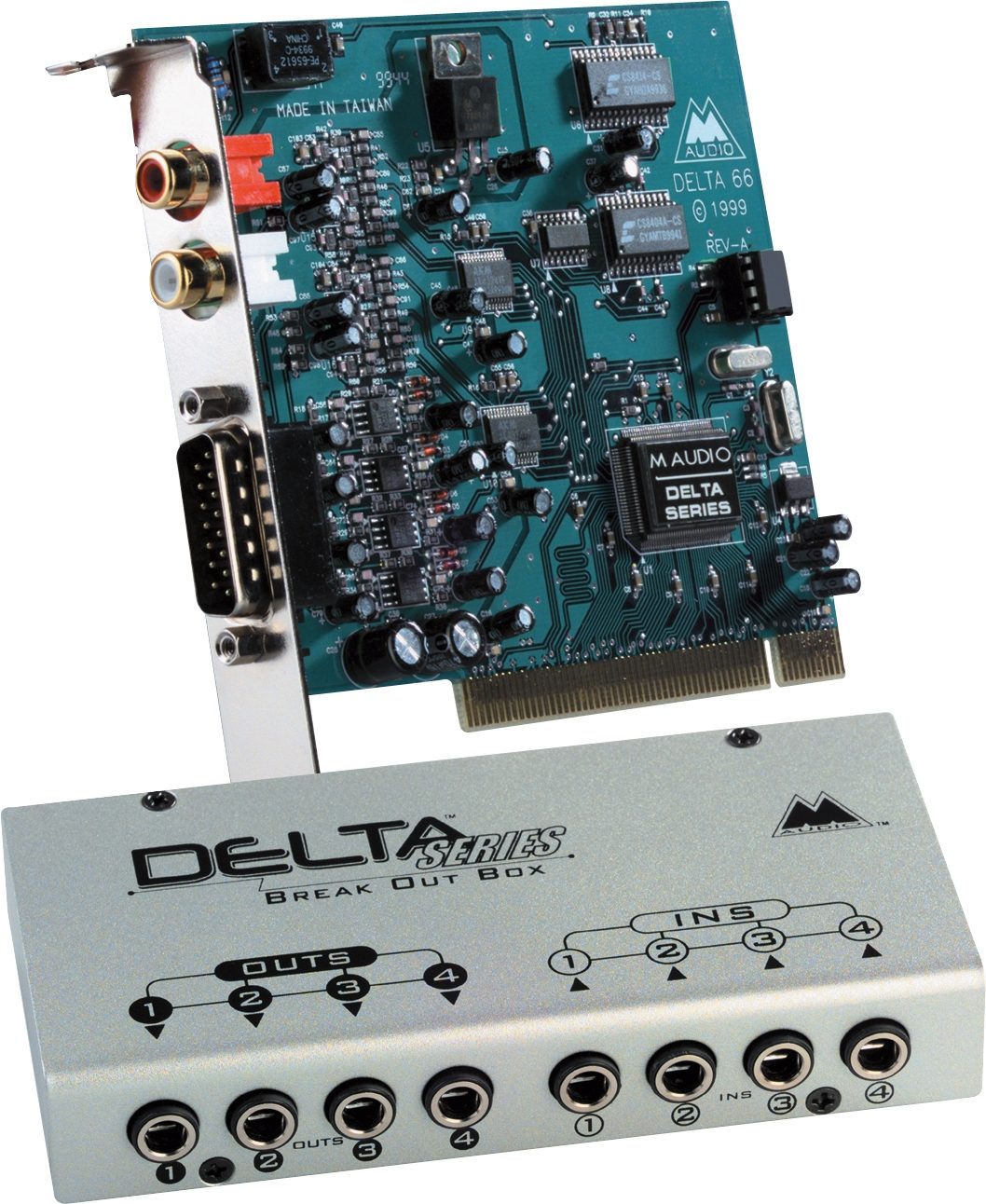
M-Audio Delta 66 Audio Interface

6x6 24-bit/96kHz full-duplex recording interface.

Our 30-Day 100% Satisfaction Guarantee applies on this item. Buy it, and if it isn't just right for you, return it!
About This Product!
Description
Docs
From Our Catalog
The Delta 66 boasts an incredible sounding converter section with 24-bit 96kHz operation. Its S/PDIF I/O makes it possible to perform digital transfers in and out of the system, useful in mastering to DAT or utilizing outboard FX via digital I/O. The breakout box handles 4 balanced or unbalanced, +4dB or -10dB signal level analog inputs and outputs. Also included is the Delta control panel software which configures the card and controls digital mixing, routing, and even SCMS (Serial Copy Management System) output on S/PDIF.

Features
6x6 24-bit/96kHz full-duplex recording interface

Configured as a PCI Host card with external audio break-out box

PCI card provides S/PDIF inputs and outputs on RCA jacks

4x4 analog break-out box accepts balanced or unbalanced connections on 1/4 in. TRS jacks.

Analog I/O configurable for +4dB and -10dB signal levels

Measured D/A specs:
103dB (A-weighted) dynamic range, 0.0015% THD @ 0dBFS

Measured A/D specs:
99dB (A-weighted) dynamic range, 0.0023% THD @ 0dBFS

All data paths support up to 24-bit/96kHz performance, no upgrades necessary

Powerful digital mixing, routing, and monitoring capabilities

Drivers include: Windows 95/98, Windows NT, ASIO, ASIO2, Direct Sound, EASI, Multi-card 95/98 and Multi-card NT (up to 3 in a system), Gigasampler, Mac Sound Manager, and Mac ASIO

Technical Info

Minimum System Requirements for PC

Windows 95, 98, or NT

Pentium II 266MHz - (96kHz operation)

Pentium 200 MMX - (48kHz or less)

128 MB of PC100 RAM - (96kHz operation)

64 MB of SDRAM - (48kHz or less)

UDMA EIDE or SCSI HDD

Minimum System Requirements for Mac

G4, G3, or G3 accelerator

128 MB RAM for 96kHz operation

96 MB RAM for 48kHz operation
For 24/96 operation with 4 channels of analog I/O, and 2 channels of digital I/O via S/PDIF, look to the Delta 66. Balanced/unbalanced, +4/-10 I/O. Compatible with Pro Tools M-Powered.

What Our Customers Say About zZounds

"It's great that you offer free shipping. I looked at several websites and you have the biggest selection and best prices." - customer on October 25, 2009

Call 866.ZZOUNDS (996.8637) and mention priority code: 79N5CCM
Item: THKMIMD662
 
Will Ship Monday
$179.00
List: $239.95
SAVE 25%
 
2 Day Shipping $6.99 | Overnight $21.99
 

Or call 866.ZZOUNDS (996.8637) right now. Mention priority code #79N5CCM when you call. You get the same low price and shipping discounts online or by phone!

No Sales Tax (Except NJ)

Seen a lower price? We'll beat it! details

 Be a zZounds Spy!

related accessories

 
from $129.00
4 payments of $99.75
 
from $9.95
 
$269.00
 
from $9.95

M-Audio Delta 66 Audio Interface Reviews

114 People rated this product :
           8 out of 10
           10 out of 10
"Ultra-quiet, flat response, good value."
When I went shopping for a decent audio interface, the Delta 66 kept coming back to me. Sales-people recommended it, it had great reviews, good support, and the price was right.

Since I purchased my own Delta 66, I have not been disappointed. A sound card just doesn't get much quieter than this. From my primitive tests, the frequency response is nice and flat from the lowest lows to the highest highs. I could find no sound coloration whatsoever. Basically, what you put in is exactly what you get out. That, more than anything, should be the overwhelming consideration for anyone who's serious about digital recording.

Hardware installation is very painless. I had the card installed and up-and-running within about 20 minutes. The supplied drivers were up-to-date and installed easily. Better yet, there are several more drivers to choose from on their excellent website, including a couple beta drivers.

The control panel software included with the Delta 66 is flexible and powerful enough to meet most any signal-routing needs. It's not the prettiest interface I've seen, and doesn't have a lot of bells and whistles, but it gets the job done. I really appreciate the "Monitor Mixer" screen with all its level meters, mute/solo functions, and precise level controls. This software does have a learning curve, so I recommend studying the manual for awhile before starting on your first project. Once you master the interface, however, you will come to appreciate the level of control you have over where and how your signals go.

I have had a few problems worth noting. While the Delta 66 and its software are excellent at handling studio hard-disk recording with software such as Cakewalk Sonar (my personal choice)...it does not exactly coexist with Windows as peacefully as it might. I use Windows 98SE and wanted to use WDM drivers so I could get the best latency from Sonar. It took me quite some time to figure out that the WDM drivers for Win98 are the same ones used for Win2000. You won't find that information on the website, exactly...so if you use Win98 and want to use WDM drivers, download the latest Win2000 WDM drivers.

Note that Windows 98 has some issues with WDM drivers that need to be addressed. You can find information about that by searching Microsoft's so-called "knowledge base" or by simply searching the web. If you don't need or use WDM drivers under Windows 98, this is of no concern.

Additionally, DirectX 8.0 doesn't seem to recognize the Delta's drivers as being DirectX friendly. I've had no trouble whatsoever with pro audio applications like Sonar (including DirectX plug-ins, they work great), but if you want to run typical Windows applications which use DirectSound (particularly games), you may find the Delta doesn't perform as well as a consumer-level card like an SBLive. This isn't an issue if you have a dedicated multitrack workstation, but if you're like me and use your computer for everything under the sun, you may hear a few quirks. Mind you, the quality of the sound itself is spectacular, you may simply find a few pops, glitches, etc. when running some Windows applications. Small price to pay, if you ask me.

There's one thing that seems to ease some of these Windows-Woes considerably. In the Control Panel under Multimedia, go to the Audio tab and click "advanced". There, click the "Peformance" tab and set the "Hardware Acceleration" slider to "None." This may help speed up some applications which make heavy use of audio, including your multi-track software. As soon as I made this change, Sonar really seemed to perk-up and run like a champ. Make a note of this if you plan on getting a Delta and use Windows 98.

Overall, I love this card. I can't say it enough, the audio quality is so good it's nearly transparent, which is exactly what you want in a DAW. Crisp highs, full-bodied lows, and everything in between. I'm a sax player, so I'm very demanding when it comes to frequency response (a sax generates a LOT of harmonics). Even the inaudible range becomes important when reproducing a tone with a lot of stacked harmonics, like the kind a saxophone produces. You may not "hear" all the frequencies, but when they're not there you can tell something's missing. With the Delta 66, when I record a sax it comes out sounding like a sax. What more could I ask for?

The breakout box is real convenience. I don't know what they crammed in there, but I doubt they could have made it any smaller, considering its four 1/4" ins and four 1/4" outs (which support balanced or unbalanced connections). I have mine velcroed to the wall above my main mixer for easy access (and it looks cool, too). :)

The S-PDIF connections (located on the soundcard--wish they were on the breakout box)...make digital connectivity possible. I use a Roland VM-3100 mixer which has digital S-PDIF ins and outs as well, which I connect to the Delta soundcard. Nice all-digital solution when I need it.

I wish the Delta had optical ins/outs, but with the S-PDIF it's little more than a matter of convenience. Digital is digital, after all. I think the AD/DA converters of the Delta sound better than those of my Roland VM-3100, so more and more I'm tending to use the Delta's analog ins over digital, anyway.

I picked the Delta over a long list of other audio cards, including some that are twice and three times the price. That includes the Echo Layla (I've heard disturbing reports about latency issues with the Layla). I have no first-hand experience with the Layla or other Echo cards, however, so do your own research if you're looking at them. Other cards I passed on included cards from EgoSys, the Aardvark Direct Pro 24/96, WaveCenter-PCI Tango24 combo, RME Digi96/8, Frontier Dakota, Terratec cards, and other cards from M-Audio. If you're seriously shopping for a card, I'd take a look at some of these for comparison (all of them are good). But I stand by my choice.

I gave it a "4" in features rather than a "5" simply because it's not the most full-featured card you'll ever find. It doesn't have any MIDI ports, no optical connections, not much in the way of bells and whistles.

But it sounds terrific. And that's what counts, isn't it?

- Heather Haze

PS: Feel free to email with (serious) questions if you plan on getting this card, and I'll try to help if I can. Please don't spam me, though. :)

hthrhaze@aol.com
Submitted: 07/24/2001
Style of Music: All kinds
7 of 7 people (100%) found this review helpful. Did you?    
Thanks for your opinion!
           10 out of 10
"Stellar Performer"
Feature:
We all know that the less 'features' there are, the better with this kind of professional product. Balanced I/O, incredible sounding converters and 24-bit/96kHz operation will do for me. Some may require more than 4 analogue inputs, though.

Quality:
This is the only part of my PC setup that has lived on unchanged through several rebuilds over the last 6 years. I expect it to still be there for years to come.

Value:
When I bought mine in 2001, it was a no-brainer. Today, of course, the days of PCI may be numbered and the marketplace is infinitely more crowded.

Desirability:
The appeal of this product stems from its top-notch sound quality, rugged construction, exemplary driver support, wide compatibility and ease of use.

Sound:
The sound quality is entirely within the professional arena.

Ease of Use:
Straightforward and intuitive in operation. Compare the no-nonsense Delta control panel with something like the horribly over-complicated and illegible Patchmix DSP (sorry emu owners!)

Support:
You simply won't need any with this product.

Overall:
I will be using my Delta 66 for as long as motherboard considerations will allow.

Submitted: 06/04/2007
Style of Music: Experimental ambient
2 of 2 people (100%) found this review helpful. Did you?    
Thanks for your opinion!
Questions? Our musicians can help you right now!
Toll Free 866.ZZOUNDS (996.8637) Open until 6 PM EST
Mention priority code 79N5CCM when you call
Toll Free En Español: 800.460.7976 Hours
Add Something to Your Cart.    
 
Shop with those who respect your privacy— we do. Copyright © 1996-2009, zZounds Music, LLC. Terms of use apply.
A-ID: 304251