

Mackie HR824MKII Powered Studio Monitor
Get the crystal-clear sound reproduction and ruler-flat frequency response that studio professionals rely on, with Mackie's bi-amped 8.75" HR824mk2 monitors.
$849.99
- 12 payments of$70.83/mo
- No Credit Check6 payments of$141.66/mo
Mackie HR824 Active Monitor
No longer available at zZounds
zZounds Gear Experts Say...
Full-range. Transparent imaging.
Overview
The HR824 in action really is a revelation. The stereo sound field is wide, deep, and incredibly detailed. High frequencies and midrange are clean and articulated. Low frequencies are no more or less than what you recorded - you can actually hear the distinct tonal qualities (and harmonic quantities) of a particular bass instrument - instead of just a "generic" bass note. Most important, the sweet spot is a broad, 3-dimensional area that gives you room to move up, down, and across the console. In short, instead of having its own distinctive "sound," the HR824 sounds like the outputs of your mixer.
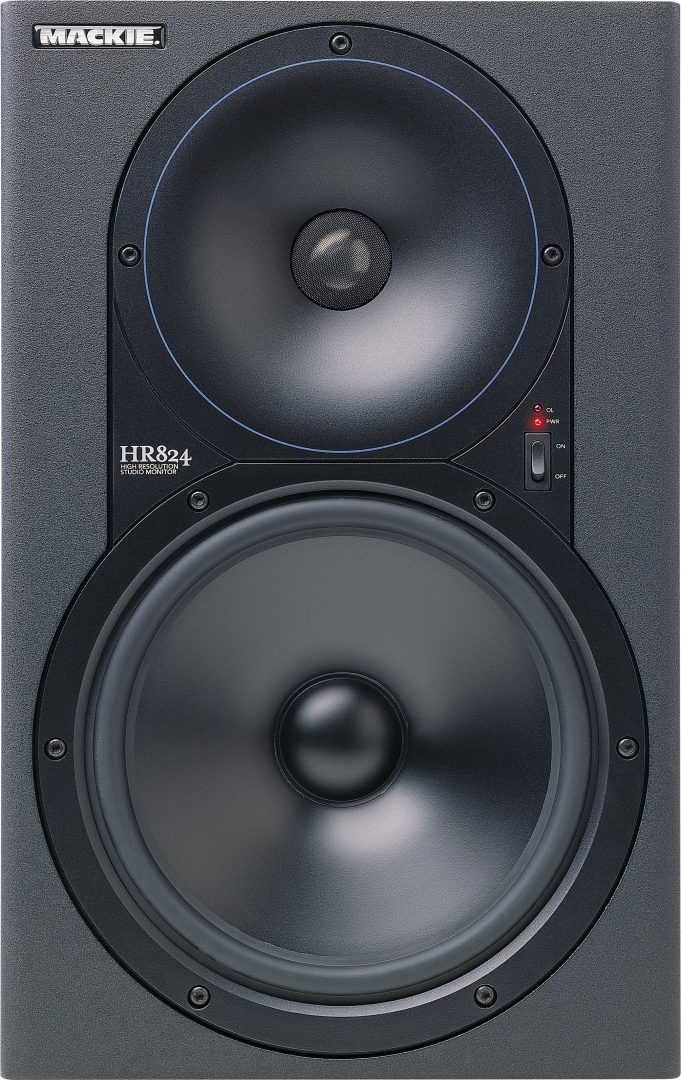
Part of the reason the HR824 has such a transparent stereo image and large sweet spot is the gently curving wave guide that encloses its alloy dome high frequency transducer. This waveguide greatly improves vertical and horizontal dispersion. In effect, it "nurtures" high frequencies created by the tweeter, guiding them as they expand out into the listening field. In comparison, a flush-mounted high frequency transducer on a passive monitor's front board has trouble coupling with the air mass of the room. It does OK directly on-axis, but can't disperse high frequencies to create a wide panoramic stereo image.
There's more. In a conventional monitor, treble (high frequency) and bass (low frequency) transducer dispersion patterns often differ significantly. Since midrange is spread between both high and low-frequency transducers, audible anomalies can occur at the crossover point.… read more The HR824's wave guide lets us match the high frequency dispersion pattern to that of the bass transducer for a seamless midrange transition. It also recesses the high frequency transducer so that its active area is on the same axis with the woofer, providing acoustic alignment of high and low frequencies.
Shouldn't a soft, light fabric dome tweeter perform better than a metal dome? Our exotic FFT laser vibration analysis proves otherwise. Fabric tweeters undulate and ripple like a pond disturbed by a big splash. After performing about a zillion tests, we found a 1 in. alloy dome tweeter that has unusually smooth response along with excellent power handling. It creates true, pistonic motion up to 22kHz and couples perfectly with our logarithmic wave guide. You get pristine, uncolored treble that defines the finest details and upper harmonics of your recordings and mixdowns.
The visible portion of the HR824's low frequency transducer system is an 8.75-inch woofer with a mineral-filled cone and extra-long-throw voice coil with an exceptionally long peak-to-peak excursion. On the business end is a massive magnet structure far larger than what could be effectively used on a passive monitor. This mono bass transducer is directly coupled in a servo loop with a 150-watt FR Series amplifier. Amp circuitry constantly monitors the LF transducer's motional parameters and applies appropriate control and damping. This constant correction produces tight, articulate bass that accurately delineates individual bass notes and kick drum impacts - without the tubbiness, distortion, or overhang common among small monitors.
Like other near-field monitors, the HR824 augments bass transducer output by constructively adding the woofer's back wave 180 degrees out of phase. Unlike other monitors, the HR824 avoids the drawbacks of ducted ports or slots that can induce power compression and low frequency distortion or cause audible vent noise. Instead, the HR824's low frequency transducer is coupled to a composite honeycomb, mass-loaded 6x12-inch elliptical passive driver that "fires" out the rear of the enclosure. With a radiating area equivalent to a 12-inch woofer, it efficiently couples the servo-controlled woofer with your control room's air mass to deliver honest, verifiably-flat response to 42Hz with a 38Hz 3dB-down point.
Naturally, the HR824's enclosure is built like a proverbial tank with 0.75 and 1 in. high-resin wood composite. But our damping extends even farther read less
Part of the reason the HR824 has such a transparent stereo image and large sweet spot is the gently curving wave guide that encloses its alloy dome high frequency transducer. This waveguide greatly improves vertical and horizontal dispersion. In effect, it "nurtures" high frequencies created by the tweeter, guiding them as they expand out into the listening field. In comparison, a flush-mounted high frequency transducer on a passive monitor's front board has trouble coupling with the air mass of the room. It does OK directly on-axis, but can't disperse high frequencies to create a wide panoramic stereo image.
There's more. In a conventional monitor, treble (high frequency) and bass (low frequency) transducer dispersion patterns often differ significantly. Since midrange is spread between both high and low-frequency transducers, audible anomalies can occur at the crossover point.… read more The HR824's wave guide lets us match the high frequency dispersion pattern to that of the bass transducer for a seamless midrange transition. It also recesses the high frequency transducer so that its active area is on the same axis with the woofer, providing acoustic alignment of high and low frequencies.
Shouldn't a soft, light fabric dome tweeter perform better than a metal dome? Our exotic FFT laser vibration analysis proves otherwise. Fabric tweeters undulate and ripple like a pond disturbed by a big splash. After performing about a zillion tests, we found a 1 in. alloy dome tweeter that has unusually smooth response along with excellent power handling. It creates true, pistonic motion up to 22kHz and couples perfectly with our logarithmic wave guide. You get pristine, uncolored treble that defines the finest details and upper harmonics of your recordings and mixdowns.
The visible portion of the HR824's low frequency transducer system is an 8.75-inch woofer with a mineral-filled cone and extra-long-throw voice coil with an exceptionally long peak-to-peak excursion. On the business end is a massive magnet structure far larger than what could be effectively used on a passive monitor. This mono bass transducer is directly coupled in a servo loop with a 150-watt FR Series amplifier. Amp circuitry constantly monitors the LF transducer's motional parameters and applies appropriate control and damping. This constant correction produces tight, articulate bass that accurately delineates individual bass notes and kick drum impacts - without the tubbiness, distortion, or overhang common among small monitors.
Like other near-field monitors, the HR824 augments bass transducer output by constructively adding the woofer's back wave 180 degrees out of phase. Unlike other monitors, the HR824 avoids the drawbacks of ducted ports or slots that can induce power compression and low frequency distortion or cause audible vent noise. Instead, the HR824's low frequency transducer is coupled to a composite honeycomb, mass-loaded 6x12-inch elliptical passive driver that "fires" out the rear of the enclosure. With a radiating area equivalent to a 12-inch woofer, it efficiently couples the servo-controlled woofer with your control room's air mass to deliver honest, verifiably-flat response to 42Hz with a 38Hz 3dB-down point.
Naturally, the HR824's enclosure is built like a proverbial tank with 0.75 and 1 in. high-resin wood composite. But our damping extends even farther read less
Specs
Enclosure Materials and Construction
3/4" (19mm) thick MDF construction with 1" (25.4mm) thick MDF front panel with radiused edges to minimize diffraction.
Proprietary exponential wave guide for controlled, wide dispersion from high-frequency driver.
Internal "H" brace adds to cabinet stiffness.
Open cell adiabatic "foam fill" acoustic damping material absorbs internal reflections, preventing delayed sound coloration.
Flush-mount connector system allows monitor to be placed against a wall without need for connector clearance.
Transducers
Low-frequency driver 8.75 in. (222mm) die-cast magnesium frame, mineral-filled polypropylene cone, oversized magnet structure, and over 16mm cone excursion.
High-frequency driver 1 in. (25.4mm) viscous edge-damped aluminum dome with ferrofluid-cooled voice coil.
Passive Radiator 6 x 12 in. (152 x 305mm) elliptical flat cone composed of aluminum honeycomb/phenolic with variable thickness filleted edge neoprene surround, mass-loaded, acoustic insulated.
Crossover Section
Crossover Type: Modified Linkwitz-Riley, 24 dB/octave @ 1800Hz
Sensitivity: 0 dBu nominal
Input Impedance: 20k ohm, balanced bridging
Compressor: Independent high and low frequency overload detection
Equalization
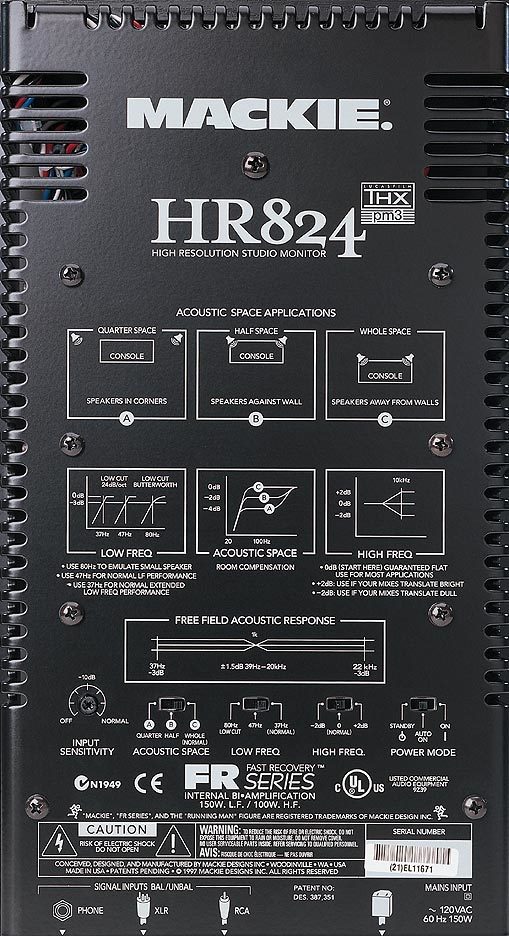
Acoustic Space Equalization (at 500Hz):
A = -4dB
B = -2dB
C = flat
Roll Off EQ: -3 dB @ 50Hz or 80Hz, 12dB/octave Multiple Feedback High Pass filter
High Freq. EQ: +/- 2 dB @ 10kHz, shelving
Acoustic Section
Free Field Frequency Response: +/-1.5 dB, 39Hz to 22kHz
Lower cutoff frequency: -3 dB @ 38Hz
Upper cutoff frequency: -3 dB @ 22.5kHz
Sound Pressure Level at 1 meter, -7.5dBu into balanced input 100dB SPL @ 1m
Maximum peak SPL per pair 121dB SPL @ 1m
Maximum short term SPL on axis, half space 80Hz to 2.5kHz 111 dB SPL @ 1m
Residual noise (maximum gain, 600 ohms source, 20Hz-20kHz bandwidth) < 8dB SPL @ 1m
3/4" (19mm) thick MDF construction with 1" (25.4mm) thick MDF front panel with radiused edges to minimize diffraction.
Proprietary exponential wave guide for controlled, wide dispersion from high-frequency driver.
Internal "H" brace adds to cabinet stiffness.
Open cell adiabatic "foam fill" acoustic damping material absorbs internal reflections, preventing delayed sound coloration.
Flush-mount connector system allows monitor to be placed against a wall without need for connector clearance.
Transducers
Low-frequency driver 8.75 in. (222mm) die-cast magnesium frame, mineral-filled polypropylene cone, oversized magnet structure, and over 16mm cone excursion.
High-frequency driver 1 in. (25.4mm) viscous edge-damped aluminum dome with ferrofluid-cooled voice coil.
Passive Radiator 6 x 12 in. (152 x 305mm) elliptical flat cone composed of aluminum honeycomb/phenolic with variable thickness filleted edge neoprene surround, mass-loaded, acoustic insulated.
Crossover Section
Crossover Type: Modified Linkwitz-Riley, 24 dB/octave @ 1800Hz
Sensitivity: 0 dBu nominal
Input Impedance: 20k ohm, balanced bridging
Compressor: Independent high and low frequency overload detection
Equalization
Acoustic Space Equalization (at 500Hz):
A = -4dB
B = -2dB
C = flat
Roll Off EQ: -3 dB @ 50Hz or 80Hz, 12dB/octave Multiple Feedback High Pass filter
High Freq. EQ: +/- 2 dB @ 10kHz, shelving
Acoustic Section
Free Field Frequency Response: +/-1.5 dB, 39Hz to 22kHz
Lower cutoff frequency: -3 dB @ 38Hz
Upper cutoff frequency: -3 dB @ 22.5kHz
Sound Pressure Level at 1 meter, -7.5dBu into balanced input 100dB SPL @ 1m
Maximum peak SPL per pair 121dB SPL @ 1m
Maximum short term SPL on axis, half space 80Hz to 2.5kHz 111 dB SPL @ 1m
Residual noise (maximum gain, 600 ohms source, 20Hz-20kHz bandwidth) < 8dB SPL @ 1m
Documents and Manuals
For support or warranty questions, please contact the manufacturer:
Phone: 800-898-3211
Email: support@mackie.com
Web: https://mackie.com/en/support/contact
Phone: 800-898-3211
Email: support@mackie.com
Web: https://mackie.com/en/support/contact
Reviews
Reviewers gave this product an overall rating of 5 out of 5 stars.
(335 ratings)
Submitted July 29, 2004 by a customer from aol.com
"Flexible, Accurate,"
Verified Customer
zZounds has verified that this reviewer made a purchase from us.
This is it. These are razor flat with no lies, 39Hz-22KHz. People argue with me that a Genelec or KRK "sounds better or brighter". That's a fine argument for a home-speaker purchase. But not for a monitor. I don't want a monitor that biases me to dull down my mixes. This is my last monitor purchase probably. I don't believe in $5,000 monitors. Because nobody you know has $5,000 home speakers, right? Okay, we all know one. Let's face it, if you can't make a mix sound good on $1,000 speakers, you are a complete loser as a mixer. Get out of the business.
Sound
The soundstage is nice and broad. AND FLAT!.
Features
The flexible EQ options on the back make it very flexible as a cart-around-with-you monitor. The intelligent connector design allows you to mount it against the wall. These people are obviously using the products they design! Nobody else does these things.
Quality
Design is well thought out, from every crossover to the passive radiator, to the venting ports, to the amplifier. Every single monitor is spec'd out. So you know what you get. Read the manual. You walk away knowing that they combed over every design option making these things. They just didn't throw in a crossover, or guess at "passive radiator design". It's a Butterworth filter for a well thought-out reason. 3rd order. not 4th. etc, etc etc. What you end up with is years of tweaking by Tweakers.… read more That's what I like to see.
Value
You DO get more monitor than any other in it's league, even tho it's the priciest in it's league. More EQ options, rolloff options, interconnection options - you ARE getting more monitor for those extra $$.
Manufacturer Support
N/C. I have had no problems as of yet.
The Wow Factor
Aesthetic Design is simple. Not extraordinary. no neon lights. don't need 'em- Amazing sound comes out of such a small space.
Musical Style:
All but Opera read less
Sound
The soundstage is nice and broad. AND FLAT!.
Features
The flexible EQ options on the back make it very flexible as a cart-around-with-you monitor. The intelligent connector design allows you to mount it against the wall. These people are obviously using the products they design! Nobody else does these things.
Quality
Design is well thought out, from every crossover to the passive radiator, to the venting ports, to the amplifier. Every single monitor is spec'd out. So you know what you get. Read the manual. You walk away knowing that they combed over every design option making these things. They just didn't throw in a crossover, or guess at "passive radiator design". It's a Butterworth filter for a well thought-out reason. 3rd order. not 4th. etc, etc etc. What you end up with is years of tweaking by Tweakers.… read more That's what I like to see.
Value
You DO get more monitor than any other in it's league, even tho it's the priciest in it's league. More EQ options, rolloff options, interconnection options - you ARE getting more monitor for those extra $$.
Manufacturer Support
N/C. I have had no problems as of yet.
The Wow Factor
Aesthetic Design is simple. Not extraordinary. no neon lights. don't need 'em- Amazing sound comes out of such a small space.
Musical Style:
All but Opera read less
9 of 9 people (100%) people found this review helpful. Did you?
Thanks for your opinion!
No longer available at zZounds

This is a carousel with product cards. Use the previous and next buttons to navigate.
People who bought this item also bought
Yamaha HS8S Active Studio Subwoofer
$499.99
- 8 payments of$62.50/mo
- No Credit Check6 payments of$83.33/mo
-

Universal Audio Apollo Twin X Duo Gen 2 Thunderbolt Audio Interface, Analog Classics Edition
$999.00
- 12 payments of$83.25/mo
- No Credit Check6 payments of$166.50/mo
-

Akai MPC Key 37 G2 Music Production Center Keyboard
$999.00
- 12 payments of$83.25/mo
- No Credit Check6 payments of$166.50/mo
-

Neumann TLM 102 Studio Microphone
$799.00
- 12 payments of$66.58/mo
- No Credit Check6 payments of$133.17/mo
Comes in 2 Colors, 2 Mfg Models-

Neumann TLM 103 Studio Microphone
$1,295.00
- 12 payments of$107.92/mo
Comes in 2 Colors, 2 Mfg Models-
KRK S10.4 Powered Studio Subwoofer (160 Watts)
$479.00
- 8 payments of$59.88/mo
- No Credit Check6 payments of$79.83/mo
-
ADAM Audio T10S Powered Studio Subwoofer Speaker
$499.99
- 8 payments of$62.50/mo
- No Credit Check6 payments of$83.33/mo
-