
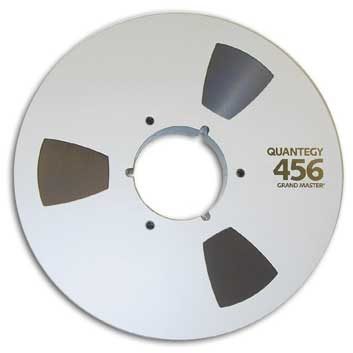
Quantegy 456 Tape On Reel
No longer available at zZounds
zZounds Gear Experts Say...
Industry Reference Standard. Reel-to-reel consistency. NAB Reel, setup box.
Overview
Reba McEntire, Queen Latifah, Metallica, Neil Young, and Eric Clapton are just a few examples of artists that have used Ampex Audio Tape exclusively in the mastering of albums that have achieved Gold status. In fact, more artists, engineers, and studios go gold on Ampex Analog and Digital Audio Tape than all other brands combined.
Though the name has changed from Ampex to Quantegy, the quality professionals expect from their analog and digital tape is higher than ever. Recently, Quantegy added the revolutionary GP9 Series to its growing audio product line.
When every note has to be pure gold, the best recording artists in the world demand Quantegy. In the motion picture and television business, Quantegy is the name you hear most often from the pros. Virtually every motion picture released from Hollywood this year featured a soundtrack recorded on Quantegy. Everything from the score of "Titanic" to the dialogue in "Saving Private Ryan" was mixed on Quantegy product.
The Standard of the Audio Recording Industry
The prominence and consistency of Grand Master(R) 456 tape have made it the reference standard against which all analog audio tapes are compared. More professional open reel tape recorders are aligned by manufacturers to 456 than all other tapes combined. If it says "Bias Compatible," it means 456.
Features:
Reel-to-Reel consistency
Elimination of Transient Errors
Industry Reference Standard
TapeCare packaging
Led by their commitment to consistency of performance,… read more the manufacturing of 456 Studio Mastering Tape is carefully controlled to maintain tight tolerances at 118 points in the manufacturing process. The "continuous flow" production system eliminates batch variations.
All slitting creates debris from the shearing of cutting blades against the tape. Only their proprietary "Total Surface Cleaning" process wipes and then vacuums every square inch of tape, thereby cleaning away all debris. This eliminates the occurrence of transient recording errors. read less
Though the name has changed from Ampex to Quantegy, the quality professionals expect from their analog and digital tape is higher than ever. Recently, Quantegy added the revolutionary GP9 Series to its growing audio product line.
When every note has to be pure gold, the best recording artists in the world demand Quantegy. In the motion picture and television business, Quantegy is the name you hear most often from the pros. Virtually every motion picture released from Hollywood this year featured a soundtrack recorded on Quantegy. Everything from the score of "Titanic" to the dialogue in "Saving Private Ryan" was mixed on Quantegy product.
The Standard of the Audio Recording Industry
The prominence and consistency of Grand Master(R) 456 tape have made it the reference standard against which all analog audio tapes are compared. More professional open reel tape recorders are aligned by manufacturers to 456 than all other tapes combined. If it says "Bias Compatible," it means 456.
Features:
Reel-to-Reel consistency
Elimination of Transient Errors
Industry Reference Standard
TapeCare packaging
Led by their commitment to consistency of performance,… read more the manufacturing of 456 Studio Mastering Tape is carefully controlled to maintain tight tolerances at 118 points in the manufacturing process. The "continuous flow" production system eliminates batch variations.
All slitting creates debris from the shearing of cutting blades against the tape. Only their proprietary "Total Surface Cleaning" process wipes and then vacuums every square inch of tape, thereby cleaning away all debris. This eliminates the occurrence of transient recording errors. read less
Specs
Electromagnetic Properties
Recommended Bias Setting: 3.0 dB *1
Sensitivity at 1 kHz: +2.0 dB *2
Sensitivity at 10 kHz: +4.0 dB *2
Third Harmonic Distortion at:
Reference Level (1 kHz): 0.1% *3
Output Level at 30/,
Third Harmonic Distortion (1 kHz): +12.3 dB *4
Weighted Signal-to-Noise Ratio:
a. related to reference level: 64.3 dB *5
b. related to output level at 3% third:
Harmonic distortion: 76.6dB *5
Modulation Noise Ratio: 76.0 dB *6
lntermodulation Distortion: 1.0% *7
Print-through: 55.0 dB *8
Magnetic Properties
Coercivfty: 330 Oe *9
Retentivity: 1460 Gs *9
Physical Properties
Thickness: Oxide Coating 0.55 mils *10
Base: 1.42 mils *10
Backcoating: 0.05 mils *10
Total: 2.02 mils *10
Standard Widths
1/4 in.: 0.246"
1/2 in.: 0.496"
1 in.: 0.997"
2 in.: 1.996"
Width Tolerance
4 in.: ±0.001"
1/2, 1, 2 in.: +0.002"
Yield Strength: 5.7 (lbs./qtr. in.) *11
Breaking Strength: 11.2 (lbs./qtr. in.) *12
Measuring Conditions
Tape Speed: 15 n./sec
Reference Level: 260 nWb/m
Record Head: Gap Length: 0.25 mils
Track Width: 70 mils
Reproduce Head: Gap Length: 0.25 mils
Track Width: 70 mils
Reproduce Equalization: 50 + 3180 Ps
Notes
1. Recommended bias setting is determined by adjusting the bias current for maximum sensitivity at 10 kHz; then increasing the bias until the sensitivity changes by 3.0 dB. The adjustment is made with a constant input voltage at approximately 10 dB below reference level. The recommended bias setting corresponds to low Third Harmonic Distortion and high output at 1 kHz.
2. Sensitivity is a measure of the output level compared to a standard reference tape (MTDED 315-2) when the recording is made at a constant input voltage approximately 10 dB below reference level and at the recommended bias setting.
3. Third harmonic distortion is the ratio between the level of the third order harmonic and the fundamental frequency (1 kHz) expressed in percent when recorded at reference level and at the recommended bias setting.
4. Output level at 3% third harmonic distortion is a measure of the output level capabilities of a tape at 1 kHz when recorded at 3% third harmonic distortion and at the recommended bias setting.
5. Weighted signal-to-noise ratio is defined as the ratio in dB between the 1 kHz output at reference level or at 3% third harmonic distortion and the ASA weighted (NAB standard) noise level. The noise measurement is made with the recommended bias and without input signal.
6. Modulation noise ratio is defined as the difference in amplitude between a 1.0 kHz signal level and its noise skirt at 800 Hz with a bandwidth of 10 Hz. The recording is made at reference level and the recommended bias.
7. Intermodulation distortion is a measure of non-linearity characterized by the appearance of frequencies in the output equal to the sums and differences of integral multiples of the component frequencies present in the input signal. The measurement employs a 4:1 (SMPTE) low frequency to high frequency voltage ratio. The recording is made at reference level and at the recommended bias setting,.
8. Print-through is the level of the accidental printing effect due to a signal recorded on an adjacent layer of tape. The printing signal is recorded at 1 kHz at reference level and the tape is hold at 7O F for 24 hours.
9. Coercivity is the magnetic field required to reduce the magnetization of a saturated magnetic specimen to zero. The coercivity is a direct measure of the bias current requirement of a tape.
10. Retentivity is the maximum remanent magnetization possible in a magnetic material. The long wavelength saturated output is directly proportional to the retentivity.
11. Coercivity and retentivity values are obtained from a 60 Hz B-H loop tester with 1 000 Oersted field calibrated to that maintained by the National Bureau of Standards.
12. Thickness measurements are made on Standard Gauges, 8000 Series, Smart Box.
13. Yield strength is defined as that force which produces 2% elongation of the samples. The measurement is made on an Instron tensile tester at a jaw separation of 5 in. and a crosshead speed of 2 in. per minute.
14. Breaking strength is the ultimate tensile strength indicating the force at which the tape breaks and is measured on an Instron tensile tester at a jaw separation of 5 in. and a crosshead speed of 2 in. per minute.
Note: Specifications are subject to change without notice.
Recommended Bias Setting: 3.0 dB *1
Sensitivity at 1 kHz: +2.0 dB *2
Sensitivity at 10 kHz: +4.0 dB *2
Third Harmonic Distortion at:
Reference Level (1 kHz): 0.1% *3
Output Level at 30/,
Third Harmonic Distortion (1 kHz): +12.3 dB *4
Weighted Signal-to-Noise Ratio:
a. related to reference level: 64.3 dB *5
b. related to output level at 3% third:
Harmonic distortion: 76.6dB *5
Modulation Noise Ratio: 76.0 dB *6
lntermodulation Distortion: 1.0% *7
Print-through: 55.0 dB *8
Magnetic Properties
Coercivfty: 330 Oe *9
Retentivity: 1460 Gs *9
Physical Properties
Thickness: Oxide Coating 0.55 mils *10
Base: 1.42 mils *10
Backcoating: 0.05 mils *10
Total: 2.02 mils *10
Standard Widths
1/4 in.: 0.246"
1/2 in.: 0.496"
1 in.: 0.997"
2 in.: 1.996"
Width Tolerance
4 in.: ±0.001"
1/2, 1, 2 in.: +0.002"
Yield Strength: 5.7 (lbs./qtr. in.) *11
Breaking Strength: 11.2 (lbs./qtr. in.) *12
Measuring Conditions
Tape Speed: 15 n./sec
Reference Level: 260 nWb/m
Record Head: Gap Length: 0.25 mils
Track Width: 70 mils
Reproduce Head: Gap Length: 0.25 mils
Track Width: 70 mils
Reproduce Equalization: 50 + 3180 Ps
Notes
1. Recommended bias setting is determined by adjusting the bias current for maximum sensitivity at 10 kHz; then increasing the bias until the sensitivity changes by 3.0 dB. The adjustment is made with a constant input voltage at approximately 10 dB below reference level. The recommended bias setting corresponds to low Third Harmonic Distortion and high output at 1 kHz.
2. Sensitivity is a measure of the output level compared to a standard reference tape (MTDED 315-2) when the recording is made at a constant input voltage approximately 10 dB below reference level and at the recommended bias setting.
3. Third harmonic distortion is the ratio between the level of the third order harmonic and the fundamental frequency (1 kHz) expressed in percent when recorded at reference level and at the recommended bias setting.
4. Output level at 3% third harmonic distortion is a measure of the output level capabilities of a tape at 1 kHz when recorded at 3% third harmonic distortion and at the recommended bias setting.
5. Weighted signal-to-noise ratio is defined as the ratio in dB between the 1 kHz output at reference level or at 3% third harmonic distortion and the ASA weighted (NAB standard) noise level. The noise measurement is made with the recommended bias and without input signal.
6. Modulation noise ratio is defined as the difference in amplitude between a 1.0 kHz signal level and its noise skirt at 800 Hz with a bandwidth of 10 Hz. The recording is made at reference level and the recommended bias.
7. Intermodulation distortion is a measure of non-linearity characterized by the appearance of frequencies in the output equal to the sums and differences of integral multiples of the component frequencies present in the input signal. The measurement employs a 4:1 (SMPTE) low frequency to high frequency voltage ratio. The recording is made at reference level and at the recommended bias setting,.
8. Print-through is the level of the accidental printing effect due to a signal recorded on an adjacent layer of tape. The printing signal is recorded at 1 kHz at reference level and the tape is hold at 7O F for 24 hours.
9. Coercivity is the magnetic field required to reduce the magnetization of a saturated magnetic specimen to zero. The coercivity is a direct measure of the bias current requirement of a tape.
10. Retentivity is the maximum remanent magnetization possible in a magnetic material. The long wavelength saturated output is directly proportional to the retentivity.
11. Coercivity and retentivity values are obtained from a 60 Hz B-H loop tester with 1 000 Oersted field calibrated to that maintained by the National Bureau of Standards.
12. Thickness measurements are made on Standard Gauges, 8000 Series, Smart Box.
13. Yield strength is defined as that force which produces 2% elongation of the samples. The measurement is made on an Instron tensile tester at a jaw separation of 5 in. and a crosshead speed of 2 in. per minute.
14. Breaking strength is the ultimate tensile strength indicating the force at which the tape breaks and is measured on an Instron tensile tester at a jaw separation of 5 in. and a crosshead speed of 2 in. per minute.
Note: Specifications are subject to change without notice.
No longer available at zZounds
In most cases, a product is unavailable because it has been discontinued by the manufacturer