
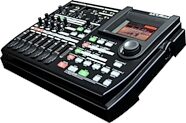
Fostex MR8 MKII 8-Track Digital Recorder
8 tracks of recording and playback using CompactFlash cards. 2 track simultaneous recording.
Overall User Ratings (based on 61 ratings)
Submitted June 1, 2006 by a customer from vt.edu
"Great value for a highly capable recorder!"
Verified Purchaser
zZounds has verified that this reviewer purchased this specific product from us.
I bought this mainly as a scratchpad to record ideas, but I may end up using this for demos, due to the simplicity of use. It will be great for location recording, then dumping the files to my computer for mixing and
Sound
Sound is comparable to most other 44.1kHz, 16-bit recorders, nothing too special. The mic preamps have limited gain however (haven't tried the phantom power yet) and I would put them a little below the level of something like the Mackie 1202VLZ I used to have. If you are recording acoustic guitars with a dynamic mic, you have to turn the gain nearly all the way up to get reasonable signal levels, which adds to the noise. The headphone amps sound okay and get plently loud without distorting. Internal effects sound okay (only if they are used sparingly), and can be used for input monitoring without printing them to the track.
The sound starts to shine when the MR-8 is fed by an external preamp. I use my Gordon Model 5, which kills the internal preamps, and the unit pretty much records the sound that you give it. In this situation, professional-quality results can be achieved.
Features
My main gripe is the lack of any type of effects loop and no EQ. The only solution I have found to this so far is to pan a channel to one side, send the signal to the unbalanced output and effects unit, then record the incoming signal to a different channel. This works fine, but makes it impossible to monitor the effects with headphones before recording, since the dry signal is always on one side. Fostex could have solved this by having an option to send a channel's signal to the output but not to the headphones. I guess the headphones and output are on the same circuit, though.
As far as the lack of EQ, I'm not sure what Fostex was thinking on this one. In most cases, it is simply not possible to get a good production unless some type of corrective EQ is added. If they just had a simple effects loop, I would be alright with the exclusion of the EQ, but they make it extremely tough (but possible) on you to add EQ, unless you export the files to your computer. Since I bought the unit to get around computer mixing, this lowers their score a little bit.
2-channels is obviously not enough to record a full-featured demo, since drums need more than 2 channels. Therefore, I recommend doing drum tracks on your computer, then importing them to the MR-8 with the .wav manager provided by Fostex. Other than that, 2 tracks is really all you need. Just forget doing a quality live-band recording, unless you are feeding off of another mixer's output.
The battery capability is awesome, and allows for easy concert-taping and location recording. Metronome button on the front is a nice addition over the previous version. The operating system is intuitive and responds fairly fast to commands. The 3 mastering effects they provide are a complete joke!
Ease of Use
If you have any idea of what you are doing, you will be recording within a few minutes of opening the box. In my opinion, this is one of the major selling points of the unit. I have more expensive, much higher-quality equipment, but will likely use this more since it is so simple.
Quality
Buttons seem a little bit fragile. I haven't had it that long, but I am predicting the buttons will be the first thing to go. Seems a little bit cheaply made, but should work fine as long as it's taken care of. Hopefully, if any of the buttons break, it is one of the 3 mastering effect buttons, since those will never be used again.
Manufacturer Support
n/a
The Wow Factor
Looks a lot better than the red one. Easily small enough to fit this, some batteries, and a couple of mics inside of a backpack, then you are carrying a functional recording studio.
Musical Background:
Long-time Hobbyist
Musical Style:
Acoustic, Rock, Alternative, Country, some Jazz
95 of 97 people (98%) people found this review helpful. Did you?
Thanks for your opinion!
Submitted March 22, 2008 by a customer from msn.com
"Nice unit but could have used a bit more thought in the design"
Verified Purchaser
zZounds has verified that this reviewer purchased this specific product from us.
I'm giving it a 7 for what it does, not for what I really want. So far, my searches have not turned up what I _really_ want: a unit about this size for recording stereo, or even better, 4-track or more, files to large memory cards; ability to do compressed files a plus. Ability to do timed (start and duration) recordings a plus. I don't need all the mixing capability the Fostex has, but I would like large, light-emitting level metering like I have on my large board. The M-Audio microtracker is too small; I want some weight and controls I can more easily use with one hand.
Sound
I don't claim a golden ear, so this is based more on technical: the specified distortion performance is decent but certainly far from state-of-the-art, and you can only record at 44.1 or 22.05 ks/s, and at 16 bit depth.
Features
My biggest disappointment is that, in this age of 4, 8 and even 16GB Compact Flash cards at reasonable prices, this puppy only will format in FAT16, which enforces a 2GB limit to the size you get, even if you put in a larger card. Also, only WAV recording is supported, no compressed formats such as MP3, OGG-Vorbis or one of the lossless compressions. Also, although you can record "stereo," it doesn't directly make a stereo wave file; you have to perform another operation to merge the two mono wave files into a single stereo one.
Ease of Use
It has taken a bit of getting used to, but the human interface is OK. Something I long for: a bit smarter entry of song names (my simple cell phone has much easier text entry). The back-lit (red for recording-related, green for playback and general) pushbuttons give good visual cues about what state things are in, and the feel of the controls is better than I expected for a low-end unit. A confusing bit: when I'm recording two channels, the remaining-time display shows the total mono track time available, which is confusing. I have to divide by two to get the remaining stereo time.
Quality
For the price, I feel like the external hardware quality is quite good. I like the pushbuttons with a positive feel, and the small sliders have a smooth feel to me. It's not my 24 channel Mackie board, but it has a good feel, to me.
Value
In spite of my complaints, I feel this unit is a reasonable value. It has a lot of features for musicians looking to do their own mixes at a price less than a month's rent (at least anywhere around here).
Manufacturer Support
A few days ago (after a few days of use) I emailed support asking about software upgrades: is there a way to do it from a computer or a flash card file? Do they have plans to support larger cards fully? Haven't heard a peep out of them yet.
The Wow Factor
Thank god they dropped the bright red on this MkII version! I'll be using it a lot to record the output of a board that's mainly used for sound reinforcement of live performances, and I don't want something too flashy.
Musical Background:
sound/recording engineer (night job...)--
Musical Style:
Many--mainly classical and Celtic--and whatever is performed on our stage
46 of 49 people (94%) people found this review helpful. Did you?
Thanks for your opinion!
Submitted April 11, 2007 by a customer from yahoo.com
"Excellent recorder, a few complicated issues."
For right now I would not replace this product for any other in its price range. If in the future I need a drum machine, I will purchase a multitracker with a drum machine built in. Compared to other multitrackers, the price is excellent. It definately helps me achieve my musical goals. I believe it would help anyone from a beginner to an absolute expert achieve their musical goals. My favorite thing about it is it's sound quality and price.
Sound
I use this product for basic home recordings. It has great sound quality. Everything flows and is very compatible with my musical sytle. Sometimes it can get a bit fuzzy but I just make minor adjustments and it's better. Every note is crystal clear and I can hear every instrument equally. But that depends on the way you record.
Features
The product came with a memory card for making saving the recordings. After a while your memory card will fill up. That's where a very useful feature comes in. You can connect the multitracker to your computer through USB cable. From there, you can transfer all your songs to the computer and actually make a cd of all the recordings. Another useful feature is the distortion. It has distortion levels for all styles of playing. I do wish it had a drum machine built in. That would be very useful for musicians without a drummer.
Ease of Use
It is fairly easy to get great sounds. But when you get it the way you like it it's totally worth the work. Modifying the sound to get your personal taste takes some experimenting but again worth the work. The manual is very clear and gives good examples of how to do things. Usually has some helpful tips for recording too. So far I have used this multitracker for my keyboard and guitar. The keyboard tends to get a little fuzzy but it's easy to fix. With the guitar, it's easy to get a crystal clear sound.
Quality
I have had a few problems with this product. It's a very durable and portable multitracker. But I have had a problem with connecting to my computer with it. The multitracker would not connect to the computer. I got a new one and it works fine now. If you're cd burning and song transfering can wait, you have nothing to worry about as far as something breaking. All controls have always worked for me. Although they are a bit sensitive. Very appropriate product for "on the road" musicians.
Value
It is a very reasonable price. Especially because of what it has to offer. Very good for beginner and expert recordings.
Manufacturer Support
I have not dealt with the company. I have needed to get the multitracker replaced. It wouldn't connect to my computer so I exchanged it for a new one at Guitar Center.
The Wow Factor
It's a very professional looking multitracker. There are lights for each button and it has a nice screen that can light up. Very nice piece of equipment.
Musical Background:
Hobbyist
Musical Style:
Rock and Punk Cabaret
14 of 16 people (88%) people found this review helpful. Did you?
Thanks for your opinion!
Submitted February 6, 2010 by a customer from msn.com
"Probably better as a multitracker than how I'm using it as a simple recorder."
Verified Purchaser
zZounds has verified that this reviewer purchased this specific product from us.
I'm keeping my eyes open for something that better serves our needs. The problem has been finding a recorder with some heft so it will stay put on a desk while you use the controls. I'd like something about the size and weight of the MR-8, but optimized as a two-track recorder that will do cuts as long as the memory supports, will use all of the CF memory, and can record MP3, OGG, and FLAC as well as WAV files.
Sound
I don't have any complaints about the sound quality. It's about as I expect from a 16-bit 44.1ks/s unit
Features
I bought the MR-8mkII to record church services; it was the size I wanted and has level metering that's reasonably easy to see. What I didn't realize were a couple of things that are quite annoying given what I want to use it for: the lack of ability to use all of a large CF card, and the fact that it stops recording at 99 minutes 59.999 seconds, with no warning. Although usually that's not a problem, sometimes it is, and when it is, it's a major problem.
I do appreciate the flexibility of the inputs, including the phantom power. The headphone output that monitors what's being recorded is a plus to me in the way I use the recorder. I see several other features that are probably very useful to some people, but I just don't have a need for them.
Ease of Use
It's generally easy to use, though labeling songs is a bit awkward, and it would be nice to be able to use names longer than 8 characters. It would be nice if it had a battery-backed real-time clock so you could tell when files were created.
Quality
Over a couple of years of use, it's held up nicely. A simple gig bag has protected it during transport, and it looks practically new.
Value
If the limitations that bother me don't apply to you, I'd say it's a reasonable value. There are now some other recorders in the same price range that would almost certainly be a better value for what I do, since I don't really need the multitracker features of the MR-8mkII.
Manufacturer Support
The Fostex International website has a firmware upgrade you can download, but I was unable to find any instructions for installing the upgrade! An email to them quite some time ago about larger CF support and the 99 minute max recording time limit went unanswered. Overall, I'm not impressed with their customer support.
The Wow Factor
It's a solid feeling unit that's done what it's capable of reliably. You might say it wasn't love at first sight, not the prettiest rose out of the box, but a rose that's kept its beauty and not faded.
Musical Background:
Church A/V director
Musical Style:
Church: music plus spoken word
4 of 4 people (100%) people found this review helpful. Did you?
Thanks for your opinion!
Submitted November 6, 2008 by a customer from pointpark.edu
"Uploading problems, terrible customer service."
Verified Customer
zZounds has verified that this reviewer made a purchase from us.
Quality
If you own a Mac I would definately suggest getting another digital recorder, as this one has endless problems when synching files. It records great, but recordings are useless if they can't be uploaded to the computer for mixing and archiving.
Value
Like I said before, worthless if you can upload tracks for mixing, wasted hours and hours watching things load endlessly.
Manufacturer Support
Sent support billions of emails, got back BS replies, never received any help despite continual requests for assistance, repeatedly got ignored by both Customer service and support although patiently waiting for and sending replies for over two months.
Musical Background:
Active Musician
Musical Style:
Acoustic Rock
15 of 19 people (79%) people found this review helpful. Did you?
Thanks for your opinion!
Submitted July 10, 2006 by a customer from hotmail.com
"Darn close to perfect."
This review has been selected by our experts as particularly helpful.
i Love this product, so buy it!
Sound
The sound on this machine is amazing, it is very respncive and all the components are very useful, even the internal mic, which is great for recording things like mandolins and ukulele thant cannot plug into the machine driectly, this is an over all perfect machine, there is no downside!
Features
As i said, every single feature is useful, all the FX, all the amp simulators, everything. There are alot of features, and all useful.
Ease of Use
This peice of equipment is very easy to use, the first day i got it i was able to record, bounce, convert to a WAV file, and then export it onto my computer.
Quality
This product will be able to stand up to the test of time, when you pick it up, you dont feel like you are going to break it, because your not, even thought it is a delicate peice of equipment, unless you drop it down a set of stairs, it should be fine
Value
This product it extreamly affordable for what you get, i love it and you will too.
Manufacturer Support
I havent had to find the support for this product yet, but one problem is that you cannot export the files on this machine to a MAC, only to windows ME, XP, and 2000. This is not a problem for most, but im sure it effects some people.
The Wow Factor
when i saw this product i knew it was the product for me, it is easy to carry around with you, not too heavy, and is durable.
Musical Background:
Starting To Record Demos
Musical Style:
Funk/Rock
12 of 20 people (60%) people found this review helpful. Did you?
Thanks for your opinion!
Submitted April 19, 2007
"Excellent value, fun unit, useful, easy to use"
I'll keep it around, cause it's good at what it does. I sometimes use it with a little stereo condenser to record live shows. Hey, it runs on batteries.
Sound
It's CD quality sound. One very important thing to realize is that the headphone amps are noisy as hell. Your actual audio is pretty clean.
The limitations I ran into as far as sound quality had far more to do with the microphones than with the inherent sound quality of the MR8.
No complaints here.
Features
It doesn't have many features, but Fostex seem to have left us the useable ones. You're always going to find things this unit doesn't do... but come on, how much did you pay for it? It's not it's big brother. I find the feature set quite useable.
Ease of Use
Most everything is easy to use. Basic transport and record controls are all right up front. For deeper stuff, if you're at all used to navigating nested menus, you'll have no trouble here... but that's not necessarily a good thing, it's just a pain some are used to. Not saying I have a better solution, just saying I end up squinting and cursing a bit while paging through menus trying to change the tempo of the click track...
Quality
Big clunky red piece of plastic. Everything's plastic. Hey, it's light! It runs on batteries... but yeah, it's glossy plastic.
Value
This is the unit I suggested to a singer/songwriter looking to get into recording her own stuff. She's familiar enough with her computer to get the files off the MR8 and make CDs, but wanted something vastly simpler than a full-blown DAW to record on, and just rented a new apartment, bought new furniture, didn't have much to spend. Her talent's gonna make up for any lack of gear, and I predict she falls in love with this thing.
Manufacturer Support
never had to deal with 'em.
The Wow Factor
Hahaha, it was sexy to me! Those sleek rounded red angles...
Come on, it's a box of bitmangling ICs.
Musical Background:
Active musician
Musical Style:
country,electronica,rock,blues
8 of 13 people (62%) people found this review helpful. Did you?
Thanks for your opinion!
Please wait.