Moog Music MF-103 Moogerfooger 12-Stage Phaser Pedal
No longer available at zZounds
zZounds Gear Experts Say...
Step on the MF-103 to give your tracks that classic "whoosh." This all-analog 12-stage phaser pedal delivers a huge range of rhythmic sweeping sounds.
Overview
The MF103 12-Stage Phaser is an all-analog effects module incorporating a 6-stage/12-stage phaser and a wide-range LFO (Low Frequency Oscillator). Its professional studio features include true 12-stage phasing (usually available only in expensive studio gear), an audio input which accepts any instrument-level or line-level signal, stereo audio outputs, and voltage control of all 4 performance parameters. Housed in a rugged steel and hardwood enclosure, the MF103 has the classic good looks, versatility, and high-quality sound of the well-known vintage Moog synthesizers.
- Designed by Robert Moog and inspired by the original… read more Moog modular synthesizers
- Control knobs for Rate, Amount, Sweep, Resonance, Drive, and Output Level
- Rate varies LFO frequency over a 250:1 range
- Amount controls how the LFO output varies the phaser sweep
- Sweet adjust phaser frequency response over a six octave range
- Resonance adjust height and sharpness of the frequency response
- Drive applies gain to the incoming audio signal
- Output Level adjusts the phased and bypassed signal
- Lo-Hi rocker switch changes LFO between low range (0.01 Hz to 2.5 Hz) and high range (1.0 Hz to 250 Hz)
- Stage rocker switch changes between 6-stage and 12-stage phasing modes
- Drive amount is visually indicated with the three-color Level LED
- LFO rate is visually indicated with the LFO LED
- Effect state is visually indicated with the two-color Bypass LED
- 1/4 inch audio input accepts any instrument-level or line-level audio signal from -16 dBm to +4 dBm (good for guitars, basses, keyboards, samples, or recorded tracks)
- 1/4-inch audio output
- 1/4-inch auxiliary output
- Independent 1/4 inch expression pedal inputs for Rate, Amount, Sweep, and Resonance (expression pedal sold separately)
- 1/4-inch sweep in replaces the LFO with an expression pedal in the 6-stage phasing circuit
- 1/4-inch LFO out sends the LFO waveform (triangler wave, +/- 2.8 volts) for use in other voltage-controlled devices
- Input impedance is one megohm and output impedance is 5,000 ohms
- A true stompbox with robust metal footswitch, black metal chassis, and real hardwood side panels
- True analog bypass
- Powered via included 9V power adapter (European or UK power adapter available separately)
- Unit weighs 2 lbs
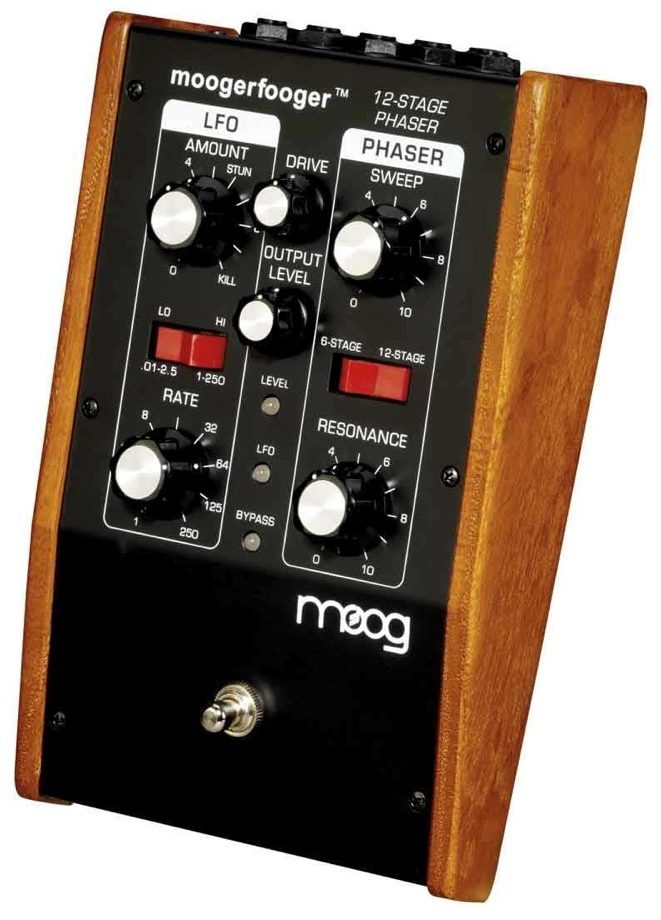
The audio level adjustments, LED indicators, and 'stomp switch' are located down the middle of the panel. The Drive adjustment matches the level of your instrument to the phaser input. The Output Level adjustment balances the loudness of the phaser and the bypassed signal. The 3-color Level light tells when the Drive adjustment is set correctly, the LFO light gives a visual indication of the LFO speed, and the 2-color Bypass light tells whether the phaser function is active or bypassed. Finally, the rugged-but-smooth-acting stomp switch enables you to switch the phaser in or out at the touch of your foot or finger.
You can plug expression pedals (such as the moogerfooger EP1) into any of these inputs. Or you can apply control voltages from devices such as modular synthesizers, MIDI-to-CV converters, or other moogerfoogers. This means that you can 'play' your MF103 from the front panel performance controls, expression pedals, and/or any other externally applied control voltages.
Sweep In lets you disconnect the LFO from part of the phase-shifting circuitry, and connect an external control voltage in its place.
The +9V DC power jack is also located on the jack panel. It accepts a wide range of standard +9V power adapters.
Moog Music is a company made up of musicians, business professionals, and technicians who work together to bring you some of the finest electronic music gear on today's market. Moog draws on a long tradition of analog design to build instruments with great sound, musician-friendly user interfaces, and rugged, good-looking classic-style enclosures. Current product lines include Etherwave and Ethervox theremins, Moogerfooger Analog Effects, and Minimoog Voyager Analog Synthesizers. All Moog Music products carry a full one-year warranty against faulty parts or workmanship, in the absence of obvious neglect or abuse. Take care of them, and they'll take care of you! read less
Pure Analog Insides -- As You'd Expect From Mr. Moog
Designed by Robert Moog himself, the MF-103 Phaser uses true analog circuitry to generate those classic "whooshing" phaser sweeps with tonal clarity that other stompboxes simply can't match. Right down to its hardwood paneling, the MF-103 Phaser oozes a level of quality and craftsmanship that you only get from a Moog. The MF-103 Phaser's real strength comes thanks to its pure analog insides. This genuine analog circuitry adds a rich, ebbing character to your sound, with a warmth that digital phaser knockoffs can't provide. So, whether you're post-processing some sci-fi sounds in the studio, or you're looking to add some vintage wobble to your guitar, bass, or keyboard, the MF-103 Phaser is a true analog stompbox that's a cut above the rest.Features:
- Phaser footpedal with pure analog circuitry- Designed by Robert Moog and inspired by the original… read more Moog modular synthesizers
- Control knobs for Rate, Amount, Sweep, Resonance, Drive, and Output Level
- Rate varies LFO frequency over a 250:1 range
- Amount controls how the LFO output varies the phaser sweep
- Sweet adjust phaser frequency response over a six octave range
- Resonance adjust height and sharpness of the frequency response
- Drive applies gain to the incoming audio signal
- Output Level adjusts the phased and bypassed signal
- Lo-Hi rocker switch changes LFO between low range (0.01 Hz to 2.5 Hz) and high range (1.0 Hz to 250 Hz)
- Stage rocker switch changes between 6-stage and 12-stage phasing modes
- Drive amount is visually indicated with the three-color Level LED
- LFO rate is visually indicated with the LFO LED
- Effect state is visually indicated with the two-color Bypass LED
- 1/4 inch audio input accepts any instrument-level or line-level audio signal from -16 dBm to +4 dBm (good for guitars, basses, keyboards, samples, or recorded tracks)
- 1/4-inch audio output
- 1/4-inch auxiliary output
- Independent 1/4 inch expression pedal inputs for Rate, Amount, Sweep, and Resonance (expression pedal sold separately)
- 1/4-inch sweep in replaces the LFO with an expression pedal in the 6-stage phasing circuit
- 1/4-inch LFO out sends the LFO waveform (triangler wave, +/- 2.8 volts) for use in other voltage-controlled devices
- Input impedance is one megohm and output impedance is 5,000 ohms
- A true stompbox with robust metal footswitch, black metal chassis, and real hardwood side panels
- True analog bypass
- Powered via included 9V power adapter (European or UK power adapter available separately)
- Unit weighs 2 lbs
What is a Phaser?
A phaser is a type of "comb filter," so called because its frequency response has several dips and peaks, like the teeth of a comb. As the phaser response sweeps back and forth across the frequency spectrum, the harmonics of the audio input signal are alternately increased and decreased. This produces the classic phaser "whooshing" sound. The MF103 produces 2 comb-filter responses. They are called "6-Stage" and "12-Stage," because of the number of phase-shifting circuits that are used internally. The 6-Stage mode has 3 dips in its frequency response, while the 12-Stage mode has 6 dips. These 2 modes have distinctly different sound qualities. In addition, the MF103 features a variable feedback circuit that increases the resonance, or 'depth' of the phaser sound.What is an LFO?
LFO stands for Low Frequency Oscillator. It produces the waveform that automatically sweeps the phaser's response back and forth across the frequency spectrum. The MF103's LFO covers an extremely wide frequency range--from slower than 1 cycle every minute to as fast as 250 cycles per second. This wide frequency range produces an enormous variety of effects, including "rotating speaker," "tremolo," and "ring modulator." And, by adjusting the strength of the LFO's waveform, you can adjust the amount of the effect, from barely perceptible to strong and dramatic.What's on the Front Panel?
The left side of the panel is the LFO. At the top is the Amount control, which adjusts the strength of the LFO waveform, and therefore the width of the phaser sweep. At the bottom is the Rate control, which adjusts the LFO's speed over a 250:1 range. Between them is the Lo-Hi switch. When the switch is on Lo, the Rate control goes from 0.01 Hz to 2.5 Hz. ("Hz" stands for Hertz. One Hertz equals one cycle per second.) When the switch is on Hi, the Rate control goes from 1 Hz to 250 Hz. The phaser controls themselves are on the right side of the panel. At the top is the Sweep control, which moves the phaser response back and forth across the frequency spectrum over a 6-octave range. At the bottom is the Resonance control, which adjusts the 'depth' of the phaser effect. Between them is the 6-Stage 12-Stage switch, which selects the phaser mode.The audio level adjustments, LED indicators, and 'stomp switch' are located down the middle of the panel. The Drive adjustment matches the level of your instrument to the phaser input. The Output Level adjustment balances the loudness of the phaser and the bypassed signal. The 3-color Level light tells when the Drive adjustment is set correctly, the LFO light gives a visual indication of the LFO speed, and the 2-color Bypass light tells whether the phaser function is active or bypassed. Finally, the rugged-but-smooth-acting stomp switch enables you to switch the phaser in or out at the touch of your foot or finger.
What's on the Jack Panel?
The jack panel has several 1/4" jacks: Audio In is what you plug your instrument or sound source into. Audio Out is the audio signal that you usually feed to your amp or mixing console. Aux Out is the audio signal that you also use when you want stereo outputs. LFO Out is the LFO waveform that you can use with other voltage-controlled devices. Rate, Amount, Sweep, and Resonance are control inputs that have the same effect as the front panel performance controls.You can plug expression pedals (such as the moogerfooger EP1) into any of these inputs. Or you can apply control voltages from devices such as modular synthesizers, MIDI-to-CV converters, or other moogerfoogers. This means that you can 'play' your MF103 from the front panel performance controls, expression pedals, and/or any other externally applied control voltages.
Sweep In lets you disconnect the LFO from part of the phase-shifting circuitry, and connect an external control voltage in its place.
The +9V DC power jack is also located on the jack panel. It accepts a wide range of standard +9V power adapters.
About Moog Music
Moog Music is an Asheville, NC-based company, bearing the name of owner and Chief Technical Officer Robert Moog. The current incarnation of Moog Music started as Big Briar, the company founded by Dr. Moog in 1978. Big Briar became Moog Music in 2002 after Dr. Moog reacquired the Moog Music trademark. The name reflects the legacy of Dr. Moog and his many years designing synthesizers, theremins, and other electronic music products. Moog Music will continue to support products with the Big Briar moniker.Moog Music is a company made up of musicians, business professionals, and technicians who work together to bring you some of the finest electronic music gear on today's market. Moog draws on a long tradition of analog design to build instruments with great sound, musician-friendly user interfaces, and rugged, good-looking classic-style enclosures. Current product lines include Etherwave and Ethervox theremins, Moogerfooger Analog Effects, and Minimoog Voyager Analog Synthesizers. All Moog Music products carry a full one-year warranty against faulty parts or workmanship, in the absence of obvious neglect or abuse. Take care of them, and they'll take care of you! read less
Specs
Features:
* RATE rotary control, which varies LFO's frequency over a 250:1 range.* AMOUNT rotary control, which adjusts the amount by which the LFO output varies the phaser sweep.
* SWEEP rotary control, which moves the phaser frequency response over a six-octave range.
* RESONANCE rotary control, which adjusts the height and sharpness of the peaks of the phaser frequency response.
* DRIVE rotary control, which adjusts the gain of the audio input to the phaser.
* OUTPUT LEVEL rotary control, which balances the phaser signals with the bypassed signal.
* LO-HI rocker switch, which chooses between the low LFO range (0.01 Hz to 2.5 Hz) and the high LFO range (1.0 Hz to 250 Hz).
* LEVEL, a three-color LED that is used to set the DRIVE control.
* LFO, a LED that indicates the LFO rate.
* BYPASS, a two-color LED that tells whether the phaser is active or bypassed.
* ON/BYPASS, a rugged, smooth-acting 'stomp switch.'
Jack Panel Features:
* AUDIO IN 1/4" phone jack - accepts any instrument-level or line-level audio signal from -16 dBm to +4 dbm. Input impedance is one megohm.* AUDIO OUT 1/4" phone jack - -4 dBm nominal output level. +8 dBm absolute maximum output level. Output impedance is 5,000 ohms.
* AUX OUT 1/4" phone jack - -4 dBm nominal output level. +8 dBm absolute maximum output level. Output impedance is 5,000 ohms.
* RATE, AMOUNT, SWEEP, RESONANCE, all of which are stereo 1/4" jacks that accept moogerfooger EP1 (or equivalent) expression pedals, or control voltages from two-circuit or three-circuit 1/4" jacks.
* SWEEP IN - provides a means of applying an external +/- 2.5 volt control signal to the second 6-section phasing circuit, in place of the LFO. Input impedance is 50,000 ohms.
* LFO OUT 1/4" phone jack - delivers the LFO waveform (triangular wave; +/- 2.8 volts) for use by other voltage-controlled devices. Output imedance is 600 ohms.
* +9V POWER INPUT jack - accepts standard 9 volt power adaptors (power adaptor included).
General Specifications:
* CASE: Black panel with hardwood sides -- classic analog appearance.* DIMENSIONS: 9" x 6" x 2-1/2"
* NET WEIGHT: 2 lb.
* SHIPPING WEIGHT: 4 lb, including power adaptor and instruction manual.
* POWER REQUIREMENTS: 105-125AC, 5W. 220AC 50Hz either European or UK style power adaptor available on special order.
Documents and Manuals
For support or warranty questions, please contact the manufacturer:
Phone: 828-251-0090
Email: techsupport@moogmusic.com
Web: https://moogmusicsupport.zendesk.com
Phone: 828-251-0090
Email: techsupport@moogmusic.com
Web: https://moogmusicsupport.zendesk.com
Moog Music's Description
Moog Music Moogerfooger MF-103 Phaser
The MF-103 12-stage phaser is a direct descendant of the original Moog modular synthesizers, yet can be used with any instrument level to line level signal. It contains two compete modular functions: a 6 or 12-stage phaser with resonance control, and wide range LFO with amount control.The 12-Stage Phaser's control parameters are Sweep frequency, Resonance, LFO Rate and LFO Amount. All of these parameters can be controlled by the great feeling knobs that beg to be tweaked as well as expression pedals or external control voltages. Panel switches select ranrge of LFO Rate and 6 or 12 stage phasing. 1/4" jacks are provided for audio input and outputs, pedal/control inputs, LFO out and auxiliary sweep input for bi-phase effects. The heavy-duty yet smooth-acting bypass switch allows tabletop or floor use.
A phaser is a type of comb filter, so called because its frequency response has several dips and peaks, like the teeth of a comb. As the phaser response sweeps back and forth across the frequency spectrum, the harmonics of the audio input signal are alternately increased and decreased. This produces the classic phaser "whooshing" sound.
Phasing is one of the best ways to impart motion to a track and to make sounds come alive. With the MF-103 Phaser you can get swirling, shimmering, vibrating effects; fill up a whole stage from one sound source; even create brand new sonic textures.
The MF-103 produces two comb-filter responses. They are called 6-Stage and 12-Stage, because of the number of phase-shifting circuits that are used internally. The 6-Stage mode has three dips in its frequency response, while the 12-Stage mode has six dips. These two modes have distinctly different sound qualities. In addition, the MF-103 features a variable feedback circuit which increases the resonance, or depth of the phaser sound.
No longer available at zZounds
In most cases, a product is unavailable because it has been discontinued by the manufacturer

This is a carousel with product cards. Use the previous and next buttons to navigate.
People who bought this item also bought

Heritage Standard H-535 Semi-Hollowbody Electric Guitar (with Case)
$1,999.00
- 12 payments of$166.58/mo
-
PRS Paul Reed Smith S2 Special Semi-Hollow Electric Guitar (with Gig Bag)
$2,599.00
- 12 payments of$216.58/mo
-
Marshall 1962 Bluesbreaker Guitar Combo Amplifier (30 Watts, 2x12")
$2,899.99
- 12 payments of$241.66/mo
-

PRS Paul Reed Smith SE NF 53 Electric Guitar (with Gig Bag)
$929.95
- 12 payments of$77.50/mo
- No Credit Check6 payments of$154.99/mo
-
Dunlop Wylde Audio Rotovibe Chorus Vibrato Pedal
$419.99
- 8 payments of$52.50/mo
- No Credit Check6 payments of$70.00/mo
-
Fender Player II Telecaster Electric Guitar, with Maple Fingerboard
$849.99
- 12 payments of$70.83/mo
- No Credit Check6 payments of$141.66/mo
-