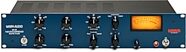
Drawmer 1969ME Tube Compressor Microphone Preamp and DI
No longer available at zZounds

zZounds Gear Experts Say...
2 mic / line pre-amps with variable gain, 48V phantom power, filters and phase reverse. 2 soft-knee tube compressors with variable threshold, attack, release and output gain.
Overview
The 1969 Mercenary Edition is a new product that derives from a collaboration between two of the audio industry's most established names, Drawmer (UK) and Mercenary Audio (USA).
When Ivor Drawmer rose to the challenge of outspoken US producer / engineer 'Fletcher' of Mercenary Audio to build a special version of the famed Drawmer 1960 (used by Eric Clapton, Madonna, Sheryl Crow, Stevie Wonder, Bryan Adams and thousands of artists around the world) -- both sides joined forces and the 1969 Mercenary Edition was born!
Features
2 mic / line pre-amps with variable gain, 48V phantom power, filters and phase reverse.
Instrument tube pre-amp with variable gain, EQ, phase reverse and brightness boost.
2 soft-knee tube compressors with variable threshold, attack, release and output gain.
True stereo link operation with "big" position for retaining bass frequencies.
Side chain access and side chain listen facility.
VU metering of gain reduction and output levels.
Individual +4 dB / -10 dB inserts / balanced +4 dB XLR input / output connectors.
Based on Drawmer's original 1960 mic pre-amp/tube compressor (itself inspired by the classic Fairchild 670), the 1969 offers a host of new features, and more impressively -- a completely new sound!
Retaining the concept of twin mic pre-amps, the 1969 uses 'Burr-Brown' op amps for a silkier sound -- and a phase reverse switch available in instrument, mic and line modes increases versatility. The 1969 employs true stereo link operation with… read more channel one's threshold, attack and release controls becoming master to both channels. Stereo link also offers a "big" position which retains bass frequencies by rolling off the detection signal at 100Hz -- minimizing undesirable pumping during compression. Output gain make-up can be independently controlled on each channel.
The 1969 Mercenary Edition incorporates new tube circuits designed to add warmth to mic / line signals, and the instrument (DI) pre-amp has its own tube stage enabling classic overdrive effects when inserting guitar, bass and other instruments -- true to the original Drawmer 1960 design.
Introduction
The 1969 is a hybrid vacuum tube / semi-conductor, dual-channel compressor which has numerous applications in studio recording, live sound, location recording, post-production and as part of a musician's rack system. A major advantage of the hybrid approach is that it combines the reliability and stability of modern solid-state designs with the warm, detailed sound of vintage classic tube designs. In addition, the 1969 incorporates two low-noise microphone preamplifiers with provision for phantom powering, plus a versatile instrument preamplifier with passive EQ and brightness switch. The instrument preamplifier may be routed through either compressor channel (or both) and is suitable for a variety of signal sources, from electric guitars and basses to electronic keyboards. It incorporates the same type of passive equalization circuitry used in traditional tube guitar amps, while the bright switch emulates the voicing of a typical guitar amplifier. This stage may be deliberately overdriven if required to add tonal coloration to an instrument, and with the addition of an external speaker simulator, overdriven guitar sounds may be directly injected ("DI'd") into the mixing console.
There are two valve stages in each audio signal path and the compressor section is designed to provide a soft-knee characteristic which contributes both to the sweet sound of the unit and to its ease of use. Switchable attack and release settings are provided along with a fully variable threshold, two of the release settings being program dependent. Traditional moving coil meters are used to monitor either the gain reduction or the output signal level while an output gain control provides up to 20 dB of make-up gain. The microphone input stages feature extremely low noise, balanced input circuitry with additional tube amplification, enabling modern microphones to take on the characteristics of older tube models. Phantom power is individually switchable on the two channels and a peak overload LED warns when clipping is imminent. Two sets of insert points on the rear panel allow additional effects to be added either before or during compression.
Applications
In addition to its more conventional applications as a general studio compressor, the 1969 is also particularly effective when used to treat complete stereo mixes. The subtle tube colorations add warmth and depth to the sound, while at the same time emphasizing mid-range and high-frequency detail. For high quality location recording, the 1969 makes the perfect partner for a DAT machine, as it combines the functions of stereo mic preamp with that of a compressor. The mic inputs provide up to 60dB of gain while maintaining a noise figure comparable with the better 'in-desk' mic preamps. Soft-knee compressors are generally preferable for unobtrusive level control and the system used in the 1969 provides firm control without the side-effects of a fixed, hard-knee design. As an instrument amplifier, the 1969 provides gain, EQ and compression making it ideal for DI'ing guitars, basses and even keyboards. The tube gain stages are versatile enough to provide a clean, punchy sound or the gain may be increased to provide the type of overdrive sound associated with tube guitar amplifiers. Furthermore, when the compressor is deliberately overdriven, it can be used creatively to produce level 'pumping' effects which can be useful both on electric guitar or rock vocal sounds. The auxiliary input may also be used for processing the output from a dedicated guitar preamplifier, where the EQ can be used to further tailor the sound before it is compressed. By adding compression to an overdriven sound, the degree of sustain can be maintained at a lower overdrive setting while the tube circuitry will add warmth and punch.
Audio Connections
The inputs and outputs are electronically balanced on conventionally wired XLRs (pin 1 screen, pin 2 hot, pin 3 cold and XLR shell is connected to chassis). The 1969 fully conforms to the EMC standards, if you propose to use the unit where it may be exposed to high levels of disturbance such as found close to a TV or radio transmitter Drawmer suggests that the screen of the signal cable is connected to the chassis connection on the XLR type connector. The operating level is nominally +4dBu. If earth loop problems are encountered, do not disconnect the mains earth but instead, try disconnecting the signal screen on one end of the cables connecting the outputs of the 1969 to the patchbay. Balanced operation is recommended. The side-chain access point and the two different level insert points are unbalanced. The intended use of the audio insert jacks would be to patch in EQ (eg 1961), reverb or similar processing. Connection is via stereo 1/4 in. jacks, the wiring convention being: ring is signal send, tip is signal return and sleeve ground.
Control Description
With the exception of the auxiliary preamp section, both channels of the 1969 are identical and may be used independently or linked for stereo operation. In both the linked modes, only channel 1 compressor controls are functional and serve as the stereo master. In stereo link mode, both channels track together to avoid the inevitable image shifting that would occur if the two channels of a stereo signal were treated independently.
Compressor
Source Select: This rotary switch selects the compressor input source. The line and mic inputs are via the rear-panel XLRs while the auxiliary input is available on the front panel. The two mic positions offer a choice of mic input with or without +48V phantom powering; a red LED indicates that phantom power is active.
Note: if the auxiliary input is to be used at the same time as a Mic input, it is recommended that the mic input be processed through the upper channel and the auxiliary input through the lower channel as this minimizes crosstalk between tube amplification stages sharing the same envelope.
Phase Reverse: This will invert the phase of the selected input signal. Use of the phase reverse feature is usually required in multi- mic situations where phase anomalies or arrival time discrepancies need to be compensated for. It is advisable to check for mono compatibility when using phase reversal within a multi-mic arrangement.
High-pass: The signal path incorporates a switchable high-pass filter which may be set to 50Hz, 100Hz or off. Its use is to attenuate low frequency signals that might otherwise prove troublesome, eg. traffic rumble or stage vibration.
Threshold: Determines the input level above which gain reduction will be applied and may be set in the range -20dB to infinity. Because the compression system is based on the soft knee principle, the onset of compression is progressive, so no ratio control is necessary.
Attack: Six switchable attack settings are provided giving various settings between a fast to a slow attack time. The actual attack time is further modified by the release setting chosen.
Release: There are three fixed release times and a further three which are program dependent. Switch settings 1 through to 3 provide progressively increasing release times, while positions 4, 5 and 6 cause the release times to vary in a manner which automatically adapts to the dynamics of the incoming signal.
Output: (Gain) The output level may be amplified or attenuated by up to 20dB to compensate for level changes caused by compression and limiting.
VU Meter: A moving coil VU meter monitors either the level of the output signal (over the range -10dB to +10dB with reference to the +4dBu operating level) or the amount of gain reduction taking place. Because the meter has VU characteristics, it closely reflects what is actually being heard, though will not respond quickly enough to register short signal peaks.
VU / GR: Switches the meters to show either the output level (VU) or the amount of gain reduction (GR).
Norm/Bypass, S/C Listen: In normal mode, the signal is passed through the compressor. Bypass only takes the compressor out of circuit leaving the vacuum tube warmth in the circuit path; the output signal is taken from the signal insert return point. S/C listen routes the side-chain signal directly to the output allowing the effects of any additional side-chain processing, such as equalization, to be monitored.
Stereo Link: Averages the left and right channel control settings when the unit is used for processing a stereo signal. The same degree of gain reduction is applied to both audio channels to prevent image shifting which would otherwise occur whenever the left and right signal dynamics varied from each other by any significant degree.
Big Link: Makes the compressor side chain less sensitive to low bass frequencies, so reducing the ducking effect caused by bass energy and effectively boosting the bass output.
Microphone Pre-amplifier
Mic Input Gain: This switchable control sets the mic input gain over the range 0 to 66dB in 6dB steps. The adjacent clip LED illuminates when excessive mic gain has been applied and there is a danger of clipping.
Auxiliary Input
The auxiliary input feeds a specialized instrument input stage which provides both gain and equalization. The passive bass and treble controls are based on those used in classic tube guitar amplifiers while the bright switch puts a peak in the frequency response at around 2kHz to simulate the voicing of a typical guitar amplifier. A two position high or low gain switch provides an additional 10dB of gain when required for level matching or for creating overdrive effects.
Bass EQ: Passive equalizer control, which can be set to provide up to 15dB of bass boost at 40Hz.
Treble EQ: Passive equalizer control, which can be set to provide up to 18dB of treble boost at 16kHz.
Gain: Provides up to 30dB of gain at the low gain switch setting or 40db at the high gain setting.
Low/High: Sensitivity selector switch. Adds 10dB of gain in the high position.
Flat/EQ: Switches the equalizer controls out of circuit when a flat response is required, or for 'A/B' comparison of EQ effectiveness.
Norm/Bright: Switches in 10dB of boost at 2kHz in the bright position, (when 'EQ' has been selected on the Flat/EQ switch.)
Operation
The unit should be connected in-line with the signal to be processed or via suitable insert points. For mono use, each channel may be considered as being completely independent and set up accordingly. For use with stereo signals such as complete mixes or submixes, the unit should be switched to stereo link mode. Setting up is simplified by the soft-knee compressor action which means that it is only necessary to adjust the threshold control until the desired degree of gain reduction is achieved. This is judged partly by ear and partly by observing the gain reduction meter. In general, a maximum gain reduction of between 10dB and 15dB will be adequate. If more gain reduction appears necessary, it is worth considering applying a conservative degree of compression during recording and then further compression while mixing. The two auto-release switch settings continually optimize the compressor action to suit the dynamics of the material being processed, setting 5 being optimized for percussive material and setting 6 for general-purpose use. Compressing during a mix does increase the subjective level of tape and other background noises during pauses and quiet passages as maximum gain is applied when the signal level is minimum. For this reason, it is unwise to use more compression than is strictly necessary. The gain control may be set to provide the required output level using the level meter as a guide. Avoid running at excessively high output levels as this reduces the available amount of signal headroom and could lead to distortion in extreme cases. The use of compression on complete mixes can cause a dulling of the sound but the 1969's tube circuitry combined with the soft-knee action helps maintain the clarity and transparency of transient sounds.
Instrument Use
The auxiliary input has a 2.2 megohm impedance and is suitable for use with both active and passive guitar pickup systems as well as with electronic keyboards. Because guitar sounds are so subjective, and because they vary so much with instrument and playing style, there are no hard and fast rules to setting up, but a good starting point is to switch bright 'on' and set the compressor for '3' or '4' attack and '6' release. The threshold should be adjusted to give a gain reduction reading of around 5dB on signal peaks. By increasing the gain control setting, the input stage can be made to overdrive in a manner similar to that of traditional valve guitar amplifiers. read less
When Ivor Drawmer rose to the challenge of outspoken US producer / engineer 'Fletcher' of Mercenary Audio to build a special version of the famed Drawmer 1960 (used by Eric Clapton, Madonna, Sheryl Crow, Stevie Wonder, Bryan Adams and thousands of artists around the world) -- both sides joined forces and the 1969 Mercenary Edition was born!
Features
2 mic / line pre-amps with variable gain, 48V phantom power, filters and phase reverse.
Instrument tube pre-amp with variable gain, EQ, phase reverse and brightness boost.
2 soft-knee tube compressors with variable threshold, attack, release and output gain.
True stereo link operation with "big" position for retaining bass frequencies.
Side chain access and side chain listen facility.
VU metering of gain reduction and output levels.
Individual +4 dB / -10 dB inserts / balanced +4 dB XLR input / output connectors.
Based on Drawmer's original 1960 mic pre-amp/tube compressor (itself inspired by the classic Fairchild 670), the 1969 offers a host of new features, and more impressively -- a completely new sound!
Retaining the concept of twin mic pre-amps, the 1969 uses 'Burr-Brown' op amps for a silkier sound -- and a phase reverse switch available in instrument, mic and line modes increases versatility. The 1969 employs true stereo link operation with… read more channel one's threshold, attack and release controls becoming master to both channels. Stereo link also offers a "big" position which retains bass frequencies by rolling off the detection signal at 100Hz -- minimizing undesirable pumping during compression. Output gain make-up can be independently controlled on each channel.
The 1969 Mercenary Edition incorporates new tube circuits designed to add warmth to mic / line signals, and the instrument (DI) pre-amp has its own tube stage enabling classic overdrive effects when inserting guitar, bass and other instruments -- true to the original Drawmer 1960 design.
Introduction
The 1969 is a hybrid vacuum tube / semi-conductor, dual-channel compressor which has numerous applications in studio recording, live sound, location recording, post-production and as part of a musician's rack system. A major advantage of the hybrid approach is that it combines the reliability and stability of modern solid-state designs with the warm, detailed sound of vintage classic tube designs. In addition, the 1969 incorporates two low-noise microphone preamplifiers with provision for phantom powering, plus a versatile instrument preamplifier with passive EQ and brightness switch. The instrument preamplifier may be routed through either compressor channel (or both) and is suitable for a variety of signal sources, from electric guitars and basses to electronic keyboards. It incorporates the same type of passive equalization circuitry used in traditional tube guitar amps, while the bright switch emulates the voicing of a typical guitar amplifier. This stage may be deliberately overdriven if required to add tonal coloration to an instrument, and with the addition of an external speaker simulator, overdriven guitar sounds may be directly injected ("DI'd") into the mixing console.
There are two valve stages in each audio signal path and the compressor section is designed to provide a soft-knee characteristic which contributes both to the sweet sound of the unit and to its ease of use. Switchable attack and release settings are provided along with a fully variable threshold, two of the release settings being program dependent. Traditional moving coil meters are used to monitor either the gain reduction or the output signal level while an output gain control provides up to 20 dB of make-up gain. The microphone input stages feature extremely low noise, balanced input circuitry with additional tube amplification, enabling modern microphones to take on the characteristics of older tube models. Phantom power is individually switchable on the two channels and a peak overload LED warns when clipping is imminent. Two sets of insert points on the rear panel allow additional effects to be added either before or during compression.
Applications
In addition to its more conventional applications as a general studio compressor, the 1969 is also particularly effective when used to treat complete stereo mixes. The subtle tube colorations add warmth and depth to the sound, while at the same time emphasizing mid-range and high-frequency detail. For high quality location recording, the 1969 makes the perfect partner for a DAT machine, as it combines the functions of stereo mic preamp with that of a compressor. The mic inputs provide up to 60dB of gain while maintaining a noise figure comparable with the better 'in-desk' mic preamps. Soft-knee compressors are generally preferable for unobtrusive level control and the system used in the 1969 provides firm control without the side-effects of a fixed, hard-knee design. As an instrument amplifier, the 1969 provides gain, EQ and compression making it ideal for DI'ing guitars, basses and even keyboards. The tube gain stages are versatile enough to provide a clean, punchy sound or the gain may be increased to provide the type of overdrive sound associated with tube guitar amplifiers. Furthermore, when the compressor is deliberately overdriven, it can be used creatively to produce level 'pumping' effects which can be useful both on electric guitar or rock vocal sounds. The auxiliary input may also be used for processing the output from a dedicated guitar preamplifier, where the EQ can be used to further tailor the sound before it is compressed. By adding compression to an overdriven sound, the degree of sustain can be maintained at a lower overdrive setting while the tube circuitry will add warmth and punch.
Audio Connections
The inputs and outputs are electronically balanced on conventionally wired XLRs (pin 1 screen, pin 2 hot, pin 3 cold and XLR shell is connected to chassis). The 1969 fully conforms to the EMC standards, if you propose to use the unit where it may be exposed to high levels of disturbance such as found close to a TV or radio transmitter Drawmer suggests that the screen of the signal cable is connected to the chassis connection on the XLR type connector. The operating level is nominally +4dBu. If earth loop problems are encountered, do not disconnect the mains earth but instead, try disconnecting the signal screen on one end of the cables connecting the outputs of the 1969 to the patchbay. Balanced operation is recommended. The side-chain access point and the two different level insert points are unbalanced. The intended use of the audio insert jacks would be to patch in EQ (eg 1961), reverb or similar processing. Connection is via stereo 1/4 in. jacks, the wiring convention being: ring is signal send, tip is signal return and sleeve ground.
Control Description
With the exception of the auxiliary preamp section, both channels of the 1969 are identical and may be used independently or linked for stereo operation. In both the linked modes, only channel 1 compressor controls are functional and serve as the stereo master. In stereo link mode, both channels track together to avoid the inevitable image shifting that would occur if the two channels of a stereo signal were treated independently.
Compressor
Source Select: This rotary switch selects the compressor input source. The line and mic inputs are via the rear-panel XLRs while the auxiliary input is available on the front panel. The two mic positions offer a choice of mic input with or without +48V phantom powering; a red LED indicates that phantom power is active.
Note: if the auxiliary input is to be used at the same time as a Mic input, it is recommended that the mic input be processed through the upper channel and the auxiliary input through the lower channel as this minimizes crosstalk between tube amplification stages sharing the same envelope.
Phase Reverse: This will invert the phase of the selected input signal. Use of the phase reverse feature is usually required in multi- mic situations where phase anomalies or arrival time discrepancies need to be compensated for. It is advisable to check for mono compatibility when using phase reversal within a multi-mic arrangement.
High-pass: The signal path incorporates a switchable high-pass filter which may be set to 50Hz, 100Hz or off. Its use is to attenuate low frequency signals that might otherwise prove troublesome, eg. traffic rumble or stage vibration.
Threshold: Determines the input level above which gain reduction will be applied and may be set in the range -20dB to infinity. Because the compression system is based on the soft knee principle, the onset of compression is progressive, so no ratio control is necessary.
Attack: Six switchable attack settings are provided giving various settings between a fast to a slow attack time. The actual attack time is further modified by the release setting chosen.
Release: There are three fixed release times and a further three which are program dependent. Switch settings 1 through to 3 provide progressively increasing release times, while positions 4, 5 and 6 cause the release times to vary in a manner which automatically adapts to the dynamics of the incoming signal.
Output: (Gain) The output level may be amplified or attenuated by up to 20dB to compensate for level changes caused by compression and limiting.
VU Meter: A moving coil VU meter monitors either the level of the output signal (over the range -10dB to +10dB with reference to the +4dBu operating level) or the amount of gain reduction taking place. Because the meter has VU characteristics, it closely reflects what is actually being heard, though will not respond quickly enough to register short signal peaks.
VU / GR: Switches the meters to show either the output level (VU) or the amount of gain reduction (GR).
Norm/Bypass, S/C Listen: In normal mode, the signal is passed through the compressor. Bypass only takes the compressor out of circuit leaving the vacuum tube warmth in the circuit path; the output signal is taken from the signal insert return point. S/C listen routes the side-chain signal directly to the output allowing the effects of any additional side-chain processing, such as equalization, to be monitored.
Stereo Link: Averages the left and right channel control settings when the unit is used for processing a stereo signal. The same degree of gain reduction is applied to both audio channels to prevent image shifting which would otherwise occur whenever the left and right signal dynamics varied from each other by any significant degree.
Big Link: Makes the compressor side chain less sensitive to low bass frequencies, so reducing the ducking effect caused by bass energy and effectively boosting the bass output.
Microphone Pre-amplifier
Mic Input Gain: This switchable control sets the mic input gain over the range 0 to 66dB in 6dB steps. The adjacent clip LED illuminates when excessive mic gain has been applied and there is a danger of clipping.
Auxiliary Input
The auxiliary input feeds a specialized instrument input stage which provides both gain and equalization. The passive bass and treble controls are based on those used in classic tube guitar amplifiers while the bright switch puts a peak in the frequency response at around 2kHz to simulate the voicing of a typical guitar amplifier. A two position high or low gain switch provides an additional 10dB of gain when required for level matching or for creating overdrive effects.
Bass EQ: Passive equalizer control, which can be set to provide up to 15dB of bass boost at 40Hz.
Treble EQ: Passive equalizer control, which can be set to provide up to 18dB of treble boost at 16kHz.
Gain: Provides up to 30dB of gain at the low gain switch setting or 40db at the high gain setting.
Low/High: Sensitivity selector switch. Adds 10dB of gain in the high position.
Flat/EQ: Switches the equalizer controls out of circuit when a flat response is required, or for 'A/B' comparison of EQ effectiveness.
Norm/Bright: Switches in 10dB of boost at 2kHz in the bright position, (when 'EQ' has been selected on the Flat/EQ switch.)
Operation
The unit should be connected in-line with the signal to be processed or via suitable insert points. For mono use, each channel may be considered as being completely independent and set up accordingly. For use with stereo signals such as complete mixes or submixes, the unit should be switched to stereo link mode. Setting up is simplified by the soft-knee compressor action which means that it is only necessary to adjust the threshold control until the desired degree of gain reduction is achieved. This is judged partly by ear and partly by observing the gain reduction meter. In general, a maximum gain reduction of between 10dB and 15dB will be adequate. If more gain reduction appears necessary, it is worth considering applying a conservative degree of compression during recording and then further compression while mixing. The two auto-release switch settings continually optimize the compressor action to suit the dynamics of the material being processed, setting 5 being optimized for percussive material and setting 6 for general-purpose use. Compressing during a mix does increase the subjective level of tape and other background noises during pauses and quiet passages as maximum gain is applied when the signal level is minimum. For this reason, it is unwise to use more compression than is strictly necessary. The gain control may be set to provide the required output level using the level meter as a guide. Avoid running at excessively high output levels as this reduces the available amount of signal headroom and could lead to distortion in extreme cases. The use of compression on complete mixes can cause a dulling of the sound but the 1969's tube circuitry combined with the soft-knee action helps maintain the clarity and transparency of transient sounds.
Instrument Use
The auxiliary input has a 2.2 megohm impedance and is suitable for use with both active and passive guitar pickup systems as well as with electronic keyboards. Because guitar sounds are so subjective, and because they vary so much with instrument and playing style, there are no hard and fast rules to setting up, but a good starting point is to switch bright 'on' and set the compressor for '3' or '4' attack and '6' release. The threshold should be adjusted to give a gain reduction reading of around 5dB on signal peaks. By increasing the gain control setting, the input stage can be made to overdrive in a manner similar to that of traditional valve guitar amplifiers. read less
Specs
(All measurements taken at +4dBu operating level)
Input impedances:
-- Line: 20k ohms
-- Mic: 150 ohms to 600 ohms
-- Aux: 2.2 megohms
Maximum input level: +20dBu
Output impedance: 50 ohms
Maximum output level: +22dB (balanced)
Bandwidth: <10Hz to 22KHz -1dB
Unity gain noise:
-- Bypass: -95dB
-- Line: -85dB
-- Mic (E.I.N.): -134.5dB shorted, -130.5dB @ 150 ohms, -129.8dB @ 200 ohms
Distortion @ 1KHz:
-- Line input with bypass selected: < 0.1%
-- Line input with normal selected: < 0.35%
Power:
-- Power requirements: 100-120Volt or 195-250Volt at 50-60Hz, 38 Watts
-- Fuse rating: 250mA for 240Volt, 500mA for 120Volt
-- Fuse type: 20mm x 5mm, Class 3 Slo-Blo, 250Volt working
Case size: 19 (w) x 3.5 (h) x 9.84 (d) in., 482mm (w) x 88mm (h) x 250mm (d)
Weight (incl packaging): 13.23 lbs, 6.0 Kgs
Release times:
-- 1 100 ms
-- 2 500ms
-- 3 1 sec
-- 4 200 ms to 2 sec semi-automatic/signal dependent
-- 5 500 ms to 5 sec semi-automatic/signal dependent
-- 6 Automatic 1 sec to 10 sec signal dependent
Input impedances:
-- Line: 20k ohms
-- Mic: 150 ohms to 600 ohms
-- Aux: 2.2 megohms
Maximum input level: +20dBu
Output impedance: 50 ohms
Maximum output level: +22dB (balanced)
Bandwidth: <10Hz to 22KHz -1dB
Unity gain noise:
-- Bypass: -95dB
-- Line: -85dB
-- Mic (E.I.N.): -134.5dB shorted, -130.5dB @ 150 ohms, -129.8dB @ 200 ohms
Distortion @ 1KHz:
-- Line input with bypass selected: < 0.1%
-- Line input with normal selected: < 0.35%
Power:
-- Power requirements: 100-120Volt or 195-250Volt at 50-60Hz, 38 Watts
-- Fuse rating: 250mA for 240Volt, 500mA for 120Volt
-- Fuse type: 20mm x 5mm, Class 3 Slo-Blo, 250Volt working
Case size: 19 (w) x 3.5 (h) x 9.84 (d) in., 482mm (w) x 88mm (h) x 250mm (d)
Weight (incl packaging): 13.23 lbs, 6.0 Kgs
Release times:
-- 1 100 ms
-- 2 500ms
-- 3 1 sec
-- 4 200 ms to 2 sec semi-automatic/signal dependent
-- 5 500 ms to 5 sec semi-automatic/signal dependent
-- 6 Automatic 1 sec to 10 sec signal dependent
No longer available at zZounds
In most cases, a product is unavailable because it has been discontinued by the manufacturer
This is a carousel with product cards. Use the previous and next buttons to navigate.
People who bought this item also bought

Warm Audio WA73-EQ 1073-Style Microphone Preamplifier and Equalizer
$899.00
- 12 payments of$74.92/mo
- No Credit Check6 payments of$149.83/mo
-


Solid State Logic SSL Revival 4000 Signature Analogue Channel Strip
$1,999.99
- 12 payments of$166.67/mo
-
Warm Audio WA-47 Large-Diaphragm Studio Tube Condenser Microphone
$999.00
- 12 payments of$83.25/mo
- No Credit Check6 payments of$166.50/mo
-
Lindell Audio Lintec Solid State Program Equalizer
$399.00
- 8 payments of$49.88/mo
- No Credit Check6 payments of$66.50/mo
-
Rupert Neve Designs Portico II Master Buss Processor Stereo Compressor
$5,299.00
- Interest-Free Payment Plans
-

Warm Audio EQP-WA Classic Passive Tube Equalizer
$799.00
- 12 payments of$66.58/mo
- No Credit Check6 payments of$133.17/mo
-